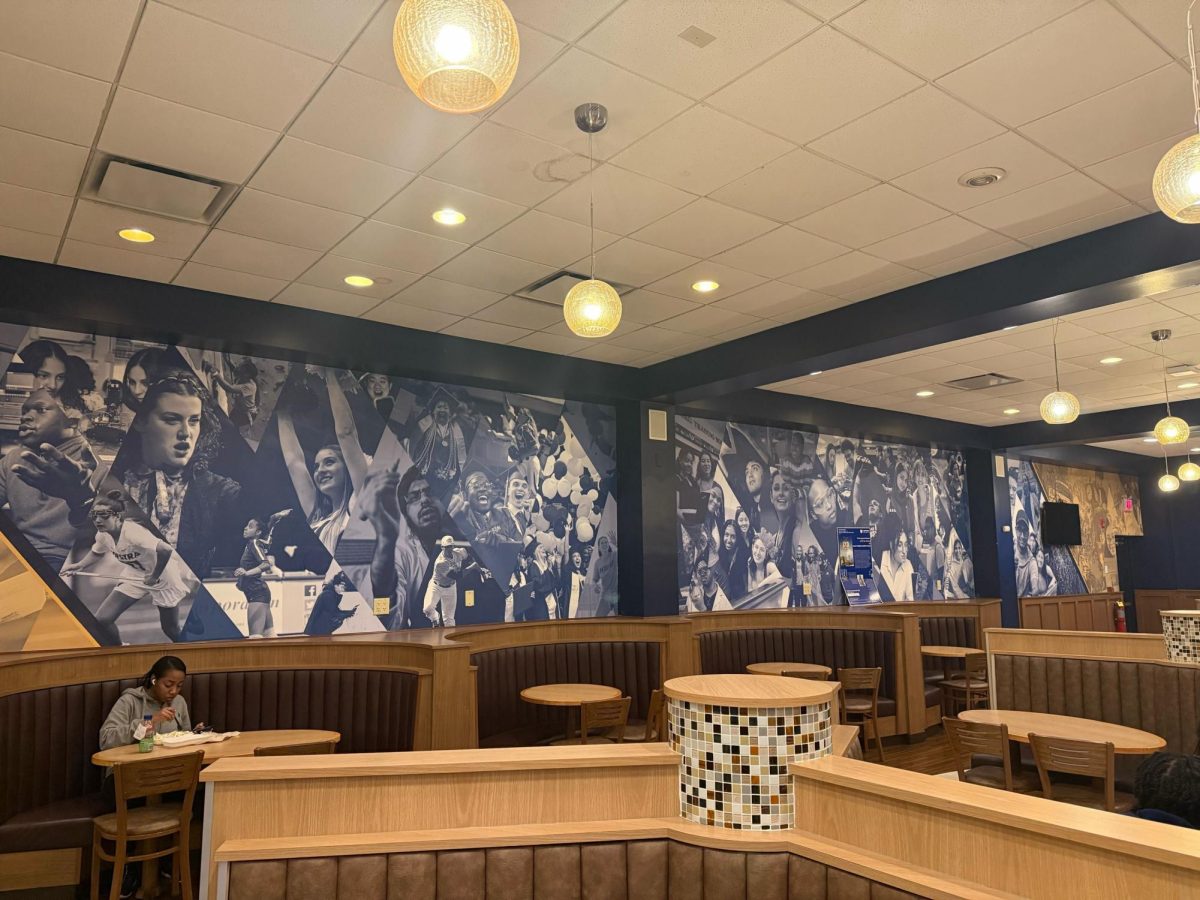
Last summer, Hofstra University renovated Hofstra USA (HofUSA). What had been a dingy dining space got upgraded with some new furniture, TouchTunes, kiosks and – most importantly to me – a mural spanning both dining rooms.
On its face, the mural isn’t anything too special. It’s a bunch of blue and yellow color-graded pictures of Hofstra students doing Hofstra student things. Frankly, the photos there aren’t too different from other pictures hung high up on the Netherlands Core’s walls, wrapped onto the hallways near the commuter lounge and plastered all over Breslin Hall. There is, however, a key difference: I know many of the folks plastered around HofUSA; I do not know most of the folks pictured everywhere else.
Seeing the renovation for the first time awakened something existential in me. It showed me that one day, these people who were – and in some cases, still are – such important fixtures in my life would one day become just like every other student whose existence is simplified to a photo on a wall: ghosts.
Like the other ghosts, those on the HofUSA mural would become nameless and two-dimensional. How could anybody possibly understand the impact each of these students had with only a picture to go off? They can’t. For a long time, I found that scary. It was difficult to grapple with the fact that people I know could become mere images decorating a wall in the span of a few short years.
If you keep going down this rabbit hole, Hofstra becomes a Ship of Theseus – changing plank by plank, student by student, until the final product becomes wholly unrecognizable from what it started as. Essentially, as students come and go, what Hofstra is changes. My trouble accepting us becoming ghosts stems from my trouble accepting that what this campus, this student body and this university means to me is disconnected from what Hofstra will become the second I graduate. It’s difficult to let go.
At its most basic level, this is an exercise in grappling with change. After four years, the student body at any university will have swapped out almost entirely, meaning the group that ushered you into the university will be fundamentally different than the one that celebrates when you cross the stage. You’re graduating from a university that has slowly replaced everybody that made it a home, and in a few years, you’ll get replaced too.
I didn’t realize it, but this crisis began before I had even experienced it. At my internship, the summer they renovated HofUSA, I ran into a Hofstra alum whose face was uncannily familiar. It was only months afterward while eating in the Netherlands that I realized where I knew her from. Among the pictures framed along the Netherlands’ walls is a photo of two students at a Pride Expo wearing colored wigs. She was one of those students. She was a ghost.
I think this ghost represents life beyond the university. You could have graduated years ago – there could be nobody left who remembers your name or even your face – but you’ve likely left your mark on Hofstra or its people in some way. The fact that the university continues changing – continues letting more people impact their peers – is inherently beautiful.
For the HofUSA mural, it’s still difficult to know that the three-dimensional people I could name will one day become nothing more than pictures on a wall. Yet at the same time, the fact that they can literally fade into the background of the university, having their impact felt but their names unknown, is one of the best fates I think I could imagine for any of us.
As much as it breaks my heart that the incoming classes won’t see the student throwing the frisbee as Georgia Shehas, the student raising her arms – diploma in hand – as Natalie Correa or the student wearing scrubs as Celeste Orellana, it’s okay for my version of Hofstra to fade. It’s okay for us to become ghosts because by the end of our time here, we will have made an impact and a legacy that goes beyond a mural – a legacy that goes beyond Hofstra.