SPOILER WARNING
Perhaps, I have been changed for the better.
The world turned pink and green again with the release of the second part of the “Wicked” movie: “Wicked: For Good.” The highly anticipated film had the job of adapting the second act of the musical, which is a difficult task in and of itself.
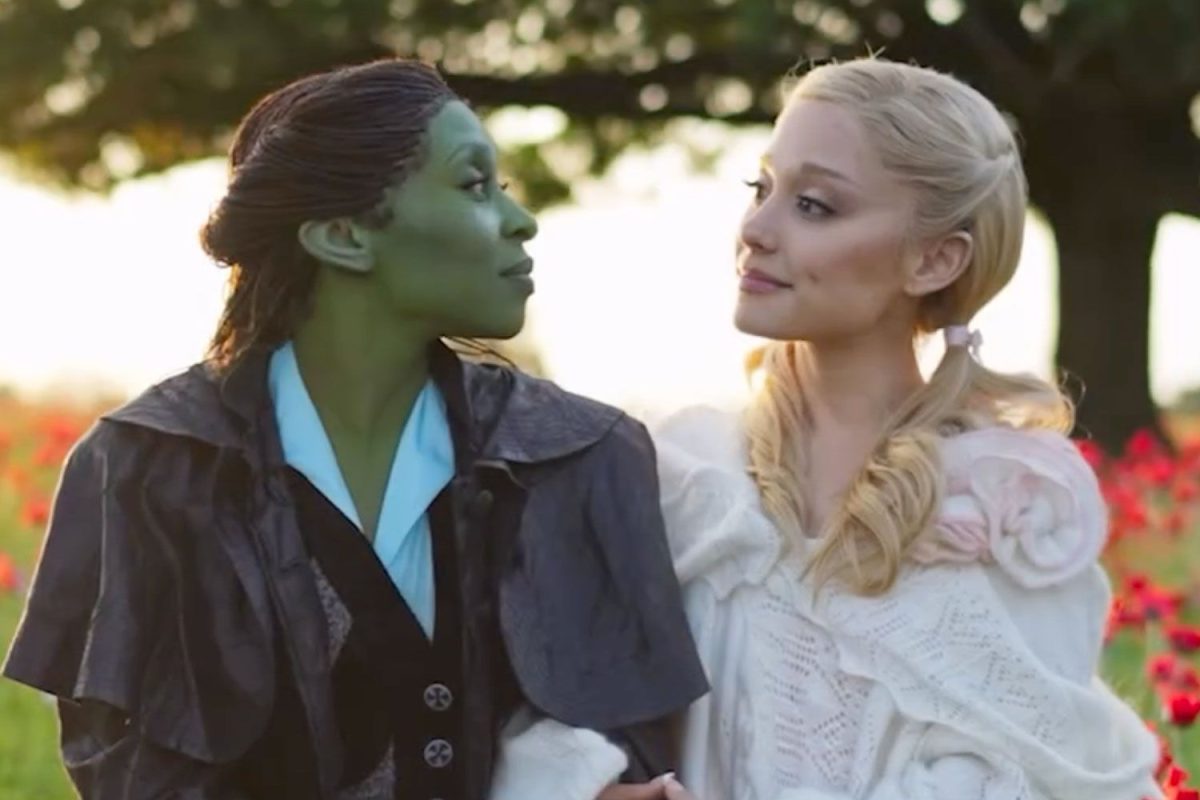
Part one of “Wicked” introduced us to the whimsical world of Oz, where we meet Galinda – later going by Glinda – Upland (Ariana Grande-Butera) and Elphaba Thropp (Cynthia Erivo). While the two loathe each other at first, they grow to become best friends before unfortunately being separated due to their different ideals. “Wicked: For Good” begins five years after these events, where the yellow brick road has just been built, and the silence of animals has been normalized.
The film opens with “Every Day More Wicked” and the iconic number “Thank Goodness.” We see Grande-Butera really shine for the first time in this film during the song, highlighting the persona Glinda is forced to play for the people of Oz – the Ozians. Throughout the song, flashes of posters with “Glinda the Good” and “The Wicked Witch” are seen everywhere, making the stances of Oz obvious. Madame Morrible (Michelle Yeoh) continues to spread lies about Elphaba, creating an enemy to suit her narrative.
The movie included two new solo songs for Glinda and Elphaba, drifting away from the original musical’s soundtrack. The two new tracks were written by Stephen Schwartz, the original composer for the “Wicked” musical, and titled “No Place Like Home” and “The Girl in the Bubble.”
For me, “No Place Like Home” was the standout of the two. Both songs were amazing, but this one stung just a bit more. Elphaba sings to explain to Dulcibear why she finds it difficult to leave Oz, despite its people’s hatred for her. Erivo does an outstanding job at showcasing Elphaba’s sentiments for Oz, wishing to make it safe again for her and the animals. This theme aligns with the current timeline we live in, where many don’t feel safe or accepted or are being forced out of the country but still find it difficult to leave what they know as home.
Marissa Bode and Ethan Slater also get their chance to shine in this movie. Bode portrays Nessarose Thropp’s frustration as the new governor of Munchkinland masterfully. Despite her short screentime, she proves herself to be a highlight by showcasing the lengths she will go to get Boq Woodsman (Slater) to love her and to separate herself from her sister.
Slater’s introduction as the Tin Man is iconic. It took me by surprise, but his performance was truly a treat. He becomes the cold piece of tin with no heart right in front of us, and Boq easily becomes just a memory.
Another new change brought into the film adaptation came during “Wonderful,” a song where The Wizard tries to lure Elphaba back onto his side. They decided to add Glinda to the number, which seems even crueler, as Glinda is clearly seen as a soft spot for Elphaba. The song also included a “Defying Gravity” reprise, where this time, Glinda is the one who tells Elphaba, “Together we’ll be the greatest team there’s ever been.”
Despite the peace we feel for maybe two seconds as an audience, Chistery shows Elphaba where The Wizard has kept even more animals trapped, including her and Glinda’s old professor, Dr. Dillamond. She immediately backtracks on the truce with The Wizard and in a chilling tone, tells him to “run.”
What follows is the better half of the movie in my opinion, despite its utter chaos. Glinda finds out about Prince Fiyero’s (Jonathan Bailey) true feelings about Elphaba, and he declares he’s running away with her. The movie heats up as Morrible tries to plan a new way to capture Elphaba, when Glinda, lost in her sadness, brings up the idea of using Nessarose. This ultimately leads to her death.
Erivo and Bailey perform the song “As Long As You’re Mine,” which is sure to grant many reactions from audiences. Their voices together are a true joy to the ear, making us feel the sultry tones of the song. Despite this being one of my absolute favorite songs from “Wicked,” the characters’ love for one another feels rushed. Though this is something that also lacked in the original musical, at least director Jon M. Chu tried his best to make it better.
Another critique that seems to be a common theme with movies today is showing way too much in the teasers and trailers. Despite there still being many surprises in the film, I felt most scenes were something I had already seen before – although it could likely be due to my knowledge of the musical itself.
A choice I did appreciate, however, was not showing Dorothy Gale’s face. “Wicked: For Good” ties into the events from the beloved movie “The Wizard of Oz” (1939) and despite the necessary presence of Dorothy, I’m glad the biggest thing in this film is still Glinda and Elphaba, just like in the musical.
Erivo’s biggest triumph, to no one’s surprise, comes during “No Good Deed.” Audiences have anticipated Erivo’s version of the song for months, and she truly exceeded expectations. The anger, desperation and acceptance to being “The Wicked Witch” all comes tumbling down in this number, and Erivo doesn’t hold back in showing it. The new vocal choices are astounding, and for fans of the “Wicked” musical, it might just top Jessica Vosk’s version. Some of the film’s best editing choices are also during this number.
In full transparency, the final act of the film feels like multiple shots to the heart.
After taking control of her own narrative, Glinda seeks out Elphaba, leading to the iconic duet, “For Good.” Multiple new choices were added from here to the end of the film. A choice that made my mouth drop was Elphaba telling Glinda, “I love you” and Glinda responding, “I love you, too.” If the duet or the affection between the two wasn’t enough to make you sob, the two-shot of the girls crying with just a closet door between them should do it.
The film concludes with Glinda truly becoming good, while Elphaba – after faking her death – and Fiyero (now Scarecrow) retreat to Kiamo Ko in peace.
Both parts of “Wicked” are films that will cement themselves in history. Chu did a tremendous job at wrapping up the stories of Glinda and Elphaba with a bittersweet bow. “Wicked: For Good” fleshes out each character more in depth compared to the second act of the musical, making it feel more complete. At the end of the day, “Wicked” is about a powerful friendship between two strong women. Their love for one another is the core of the story, ultimately changing one another, and us, for good.