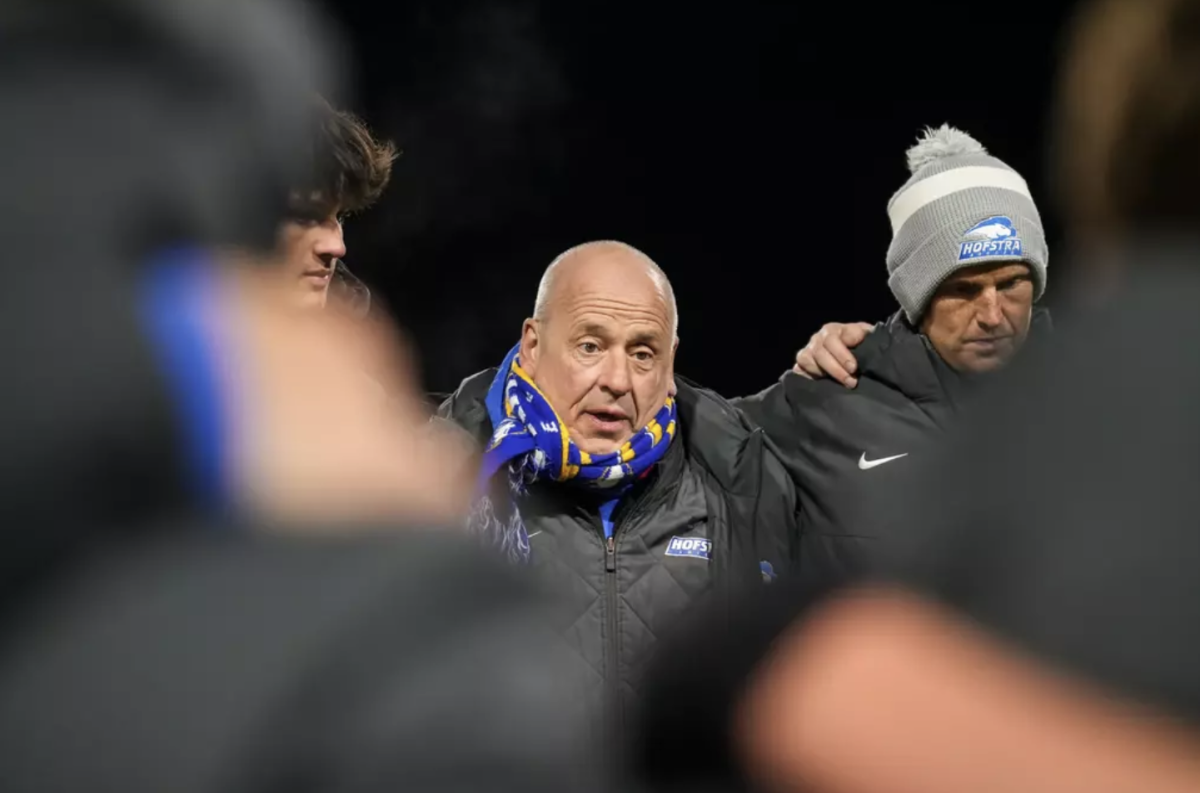

What makes a successful college athletics program? Is it great players, coaches, a university with a great reputation and resources for its players? Perhaps it’s the culture or history of winning. Hofstra University men’s soccer head coach Richard Nuttall represents all of this and then some. To put it plainly, Nuttall is the men’s soccer program. Over the last 37 years, Nuttall has seen the men’s soccer team grow into one of the most successful and well-recognized teams in the nation.
Before Nuttall arrived in 1989, the Hofstra men’s soccer team had 11 winning seasons in its 33 years of existence, winning just one East Coast Conference Championship in 1985. Nuttall became the ninth head coach in the program’s history and is the only coach to spend more than 11 years with the program.
To say Nuttall is synonymous with the men’s soccer program would be an understatement, but ask him, and he will say this was never meant to happen.
“I fell into it,” Nuttall said. “I was playing in a very high level, level five in England, which is still very good, and teaching. And the teacher there was a guy called Pete Casket. He asked me to help him with the town team, so I started off coaching and playing.”
Nuttall spent the next few years traveling between England and the United States, playing for a local men’s team in Glen Cove, New York, and working as a physical education teacher at North Shore High School in Glen Head, New York. It was there that he met his teammates, many of whom were Hofstra graduates. Eventually, the head coach position opened at Hofstra. Nuttall applied and got the job. The rest is history.
“My interest just grew from there,” Nuttall said. “I thought, ‘I’ll do this job for two or three years,’ and then I was thinking about going and living and playing in Australia. But I got a severe injury with the knee … I was enjoying life here.”
With Nuttall now at Hofstra for so long, he can’t imagine a better job than the one he’s held on to for nearly four decades.
“What more do you want?” Nuttall said. “Come to work with young people, you know, on the men’s team, the people of the same ilk as me, people who love the sport. It’s been very few days I didn’t want to come to work.”
Nuttall’s success wasn’t overnight. His first few seasons at the helm were a struggle. The team went 4-15-1 in his first season and wouldn’t record a winning season until Nuttall’s fifth season in 1993.
Nuttall had to grow into his new role and learn some valuable lessons to build the program from the ground up.
“I think just working hard,” Nuttall said. “The [Athletic Director] at the time said, ‘Look, I know you think you’re a great coach, but I don’t care how good a coach you are.’ He said, ‘It’s the players you [bring] in that will make the program.’ So that stuck with me, and just getting the best players possible … We never really lost many transfers. They had a great experience, they enjoyed Hofstra and we built slowly over time.”
Nuttall wasn’t just growing as a coach. He was still a young man, adjusting to a new life in a new country. It took some time until he truly felt at home on Long Island.
“I met my wife Christine about 30 odd years ago,” Nuttall said. “First few years were a bit rocky, shall we say. But I married her, and you know, having kids, all this stuff at 27, 28 [years-old]. I just love Long Island. Long Island’s got everything. It’s got entertainment, it’s got beaches, it’s got the city, it’s got the travelers, it’s got the sports teams. After four or five years at Hofstra, and things were getting better, I just sort of [thought], ‘This is a great place to be.’”
The tides were turning, not just in Nuttall’s personal life, but on the field as well, although the results didn’t appear right away.
When Hofstra joined the North Atlantic Conference in 1995, Nuttall’s team went 3-16, by far his worst season, but the trust he earned from Hofstra allowed him to find his way as a winning coach.
“That was a tough one,” Nuttall said. “But look, you’ve just got to keep going and build and build and build. Thankfully, Hofstra kept me employed and allowed me to keep my job and to keep building the program.”
Learning how to lose is an important step for a coach, and the adversity that Nuttall faced early on in his time at Hofstra allowed him to build the mental fortitude to finally start winning.
“I try to internalize most of [losing] because I’m the leader of the group, and my actions, generally speaking, have got to be the best they can be to help the group,” Nuttall said. “The tough losses stay with you … It’s all about the next step in the journey. As you get older, you learn. It’s easier to [not] take the next step when you’re younger and a bit raw and emotional; it’s not as easy, but I’m used to it now. I’m used to the eyes on us. I tell all the new coaches here, ‘Don’t get too high when you win, and don’t get too low when you lose, and I think that’s the secret to coaching.’”
By 1997, Hofstra joined the America East Conference and went 14-4-3 with a perfect 9-0 in conference play, winning the regular season title. Nuttall led Hofstra to three winning seasons over the next five years before joining the then-called Colonial Athletic Association (CAA) in 2003.
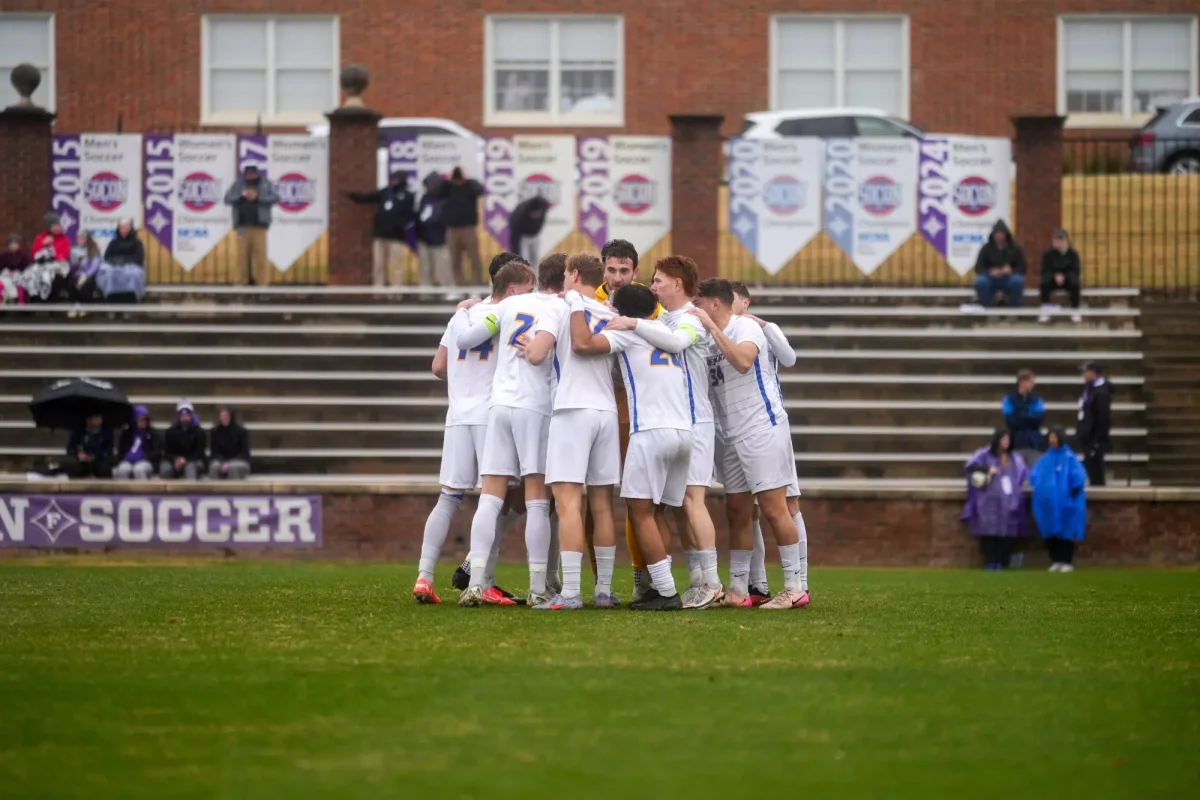
From 2004 on, Hofstra only had three losing seasons under Nuttall. The team won the first of eight CAA championships and made its first NCAA tournament appearance since 1968. Nuttall’s side won three straight CAA championships from 2004-2006, making the second round of the NCAA tournament two times.
“I mean, the first one’s always special, but each year it gets better,” Nuttall said. “You just go in with different players, with different experiences. You’ve got different memories on the way to each one. How you get there is different each time, and the types of teams you have are different. They all have their own identity, and you remember all the players from each team and who they are and what they were.”
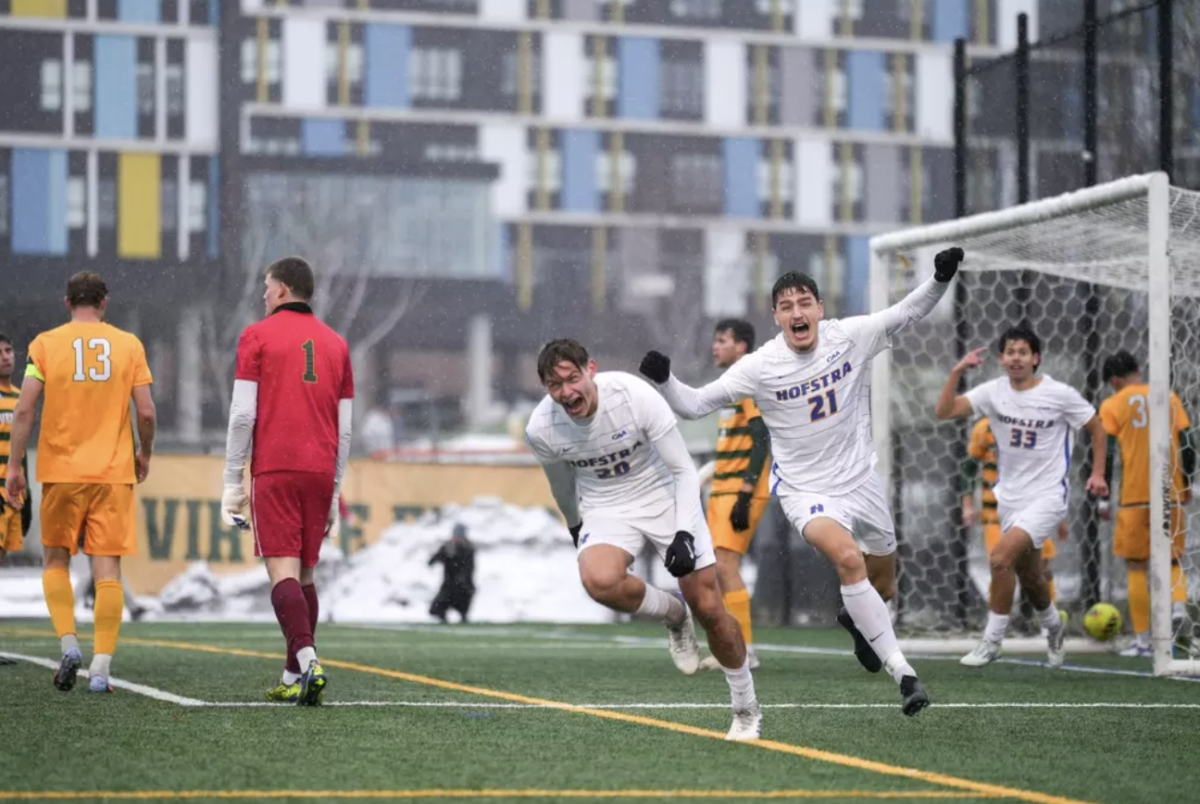
Nuttall captained the ship through two dynasties. First with the three-peat in 2006, and again in 2024 after the Pride became the first team in CAA history to win four straight conference championships. While it’s hard enough to win one championship, the constant turnover from year to year for a college program makes sustained success even more difficult, but Nuttall has seemed to find the recipe for winning.
“I think players come and go, don’t they? But I think the processes remain relatively the same,” Nuttall said. “You don’t motivate all players the same way. You’ve got to be a little bit different every year, depending on your clientele, who’s in your team, and understand how they are … You manage them slightly differently each year, but underlying our culture, our general culture of accountability, directness, hard work, organization and ability to let skillful players play in the right areas, yet retain the workman-like performances, that stays the same.”
That system has pushed the Pride to be the team with the most wins in the nation since 2021, developing hundreds of players along the way. Nuttall has coached nine All-Americans, 36 All-Region selections, over 90 All-Conference players across three different conferences, five CAA Player of the Year winners, five CAA Defensive Player of the Year winners and 29 players who have gone on to play professionally in the MLS and United Soccer Leagues.
While scouting talent is part of the job, it’s convincing those recruits to commit and join the team where the challenge lies. Luckily for Nuttall, being in what he calls “the greatest city in the world” helps a lot as well. Even if he does leave out how bad the traffic can be.
“I [say], ‘It’s incredible people and I love coming to work every day,’ and I sell them on that. I sell them on the people, the culture within the program. I sell them on the academics, the facilities and the success of the program now. I suppose … I sell them on my coaching staff being great, existing players and a chance to be successful, and I sell them on maybe becoming a future pro and if not, we help all of our players in their job search after college anyway, so I settle them on that.”
Outside of winning a national championship, Nuttall has accomplished nearly all there is in college soccer. Suddenly, 37 years have passed, and now Nuttall must face a new challenge in his life – saying goodbye.
“When you’re younger, you don’t really think, do you? Just like what’s happening in the next 10 minutes,” Nuttall said. “I would never have thought I’d be here for 37 years. No chance. I’m the son of a pig farmer. So, being at a major university for 37 years, it’s not bad, is it?”
While Nuttall still feels like he can coach for another decade, he understands that his time is up.
“There was many factors,” Nuttall said. “Great assistance, 37 years, we’ve been brilliant for the last seven or eight years. Let somebody else move them further forward. Time with my family and wife, Christine, and time with the kids, you know, I want to be part of their lives.”
Nuttall won’t be gone completely. He will be taking on a new administrative role as Assistant Director of Athletics for Development and Alumni Affairs. He hopes to still provide support for the men’s and women’s soccer teams, while also mentoring other coaches across Hofstra. Students and faculty may even see Nutall around campus supporting other teams from the stands.
“I will help both men’s and women’s soccer with fundraising and then events, and then whatever else they tell me to do, I’ll do it,” Nuttall said. “I’ll be at the basketball games, which I love watching [sports] anyway.”
Until then, and until the day Nuttall finally leaves Hofstra for good, he’s going to look forward to coming into work every day.
“I love walking into the [Athletics] building because everybody in the building gives me energy,” Nuttall said.
With Nuttall’s time as head coach coming to an end, it’s a chance to catch up on all that he’s missed. Nuttall is a soccer lifer, meaning someone whose life and career have been consumed by soccer and will continue to dominate his life after Hofstra, but he still wants to make room for his family and thank them for sticking by his side the whole way.
“[To] my wife, I want to say thank you,” Nuttall said. “She’s supported me all this time. I don’t know if we’re still together either … I’m being honest. I’m never there. She’s done a lot, bringing up the kids, and being where I am, I miss a lot of parties and not being there a lot. So, I think I’m very thankful to my wife for sticking with me through thick and thin.”
The Pride now await their fate, as their NCAA tournament hopes lie within the NCAA Men’s Soccer Committee, who decide at large bids in the tournament.