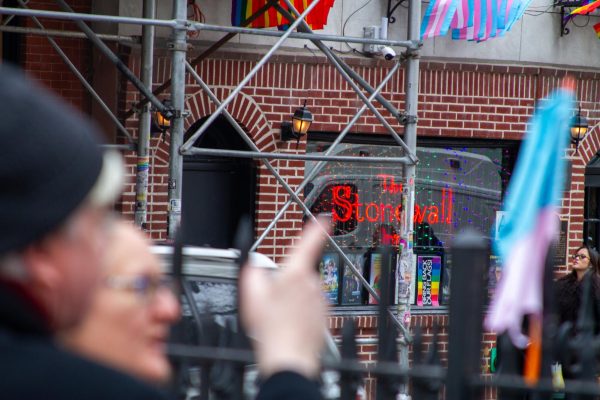

On Monday, Feb. 9, the Pride flag flying over the Stonewall National Monument was taken down by National Park Service (NPS) employees in compliance with a directive from the Trump-Vance administration.
In response to inquiries from outraged members of the LGBTQ+ community, NPS released a statement on the matter explaining that in accordance with new policies enacted by the current presidential administration, “only the U.S. flag and other congressionally or departmentally authorized flags are flown on NPS-managed flagpoles, with limited exceptions.”
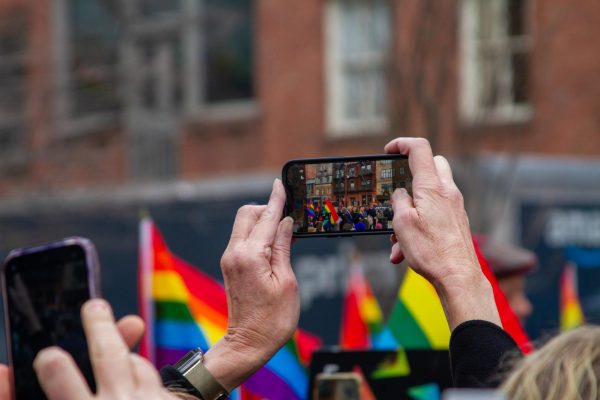
On Wednesday, Feb. 11, hundreds of demonstrators gathered in front of the bare flagpole on Christopher Street. Jay W. Walker, co-founder of the ReClaim Pride Coalition and the Queer Liberation March, decided to organize the demonstration after hearing that there was an official press conference scheduled for later in the week. Walker felt that the community deserved an immediate response and organized the rally that very same day.
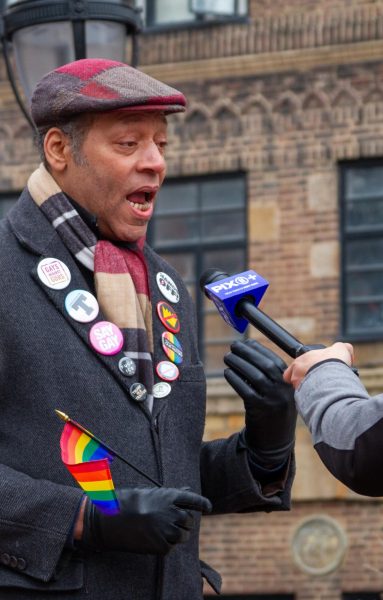
Hundreds of people were in attendance. Walker returned to the Monument every day since the flag’s removal and told the crowd that each time their flag is removed, he will raise another in its place as an act of civil disobedience.
Federally enforced acts of erasure have become commonplace during President Donald Trump’s second term as president and are reminiscent of this Administration’s repeated removal of plaques, monuments and museum exhibits that are meant to display United States history.
“With the Trump administration, there is a particular investment in erasing any kind of history or proof of there being opposition to mass bigotry. They are really invested in making it seem as though there is no precedent for there being any type of resistance or pushback to social authoritarianism,” said Grayson Lazarus, adjunct professor within the department of Radio, Television, Film at Hofstra University. “There is a top-down assault on all marginalized communities right now. It’s an active warzone, not just literally on the streets in many cases, but also in textbooks and museums.”
Corbin Wolfendale, a sophomore music business major, talked of the importance of recognizing our historical struggles.
“About a year ago, the Trump administration required government websites to shorten the acronym ‘LGBTQ’ to just ‘LGB.’ The erasure of trans people is just the first step in the broader wish that the Trump administration has where they want to erase all mentions of Queer people … They’re starting with the most vulnerable group of people which is trans people,” said Wolfendale. “It’s a lot harder to connect with your past and the people who fought for your rights when you don’t even know they existed. The whole goal of that is just to disconnect us from our communities and scare us into submission. We can’t just hide and let history go. We have to fight for it, because it’s one of the most important things we have as a minority in this country.”
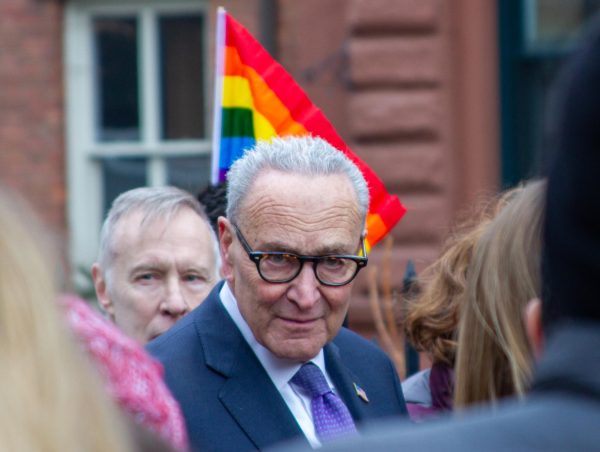
State government officials held a press conference on Sunday, Feb. 15, in front of the Stonewall National Monument formally condemning the Trump administration’s actions. The removal of the only officially sanctioned Pride Flag on federally owned land in the U.S. sparked immediate backlash from local and federal officials, with Senate Minority Leader Chuck Schumer (D-NY) addressing a crowd of demonstrators in front of the Memorial.
“The Trump administration’s removal of the Pride Rainbow Flag … is a deeply outrageous action that must be reversed, it’s an effing disgrace,” Schumer said.
Other officials who attended the demonstration on Sunday included Senator Eric Bottcher (D-NY) and Manhattan Borough President Brad Hoylman-Sigal.
“I hear a lot of people saying ‘Oh, I’m not going to watch the news anymore.’ That’s a privilege – for you not to tune in, for you not to know what is happening to your brother or sister. We are all connected. It’s the pride flag today, tomorrow it’s going to hit home for you. You have to be cognizant of the shifts that are happening,” said Sekiya Dorsett, assistant professor within the department of Radio, Television, Film. “At this moment, unfortunately, there are so many things occurring that we honestly cannot keep up. Social media has us in a mindless loop at times. This story is important. We cannot let anything slip by. We must report on everything, stand up for every part of our psyche which is under attack. If the name of the country is the United States of America, then the country should reflect that name in its legislation.”
The Stonewall National Monument was established in 2016 by former President Barack Obama to honor and memorialize the 1969 Stonewall Uprising’s role in the LGBTQ+ civil rights movement and has become a place of pilgrimage for many Queer Americans. The name Stonewall is synonymous with the idea of Queer resilience in the face of oppression and discrimination.
“When the Pride flag flies, it’s not simply a reminder of Stonewall in 1969. It is a reminder that we as Queer people across the globe are here, are present, are living and are loving. We have fought and are now celebrating,” Dorsett said. “When you see that flag, it’s an identity of who we are as a people.”
The first Pride flag was created by Gilbert Baker in 1978 following the assassination of Harvey Milk, the first openly gay man elected to public office in the state of California. The original rainbow flag created by Baker had eight colors, each representing a different aspect of life.
“A flag is not a threatening thing. If you don’t identify with that flag, that’s okay. It should just be something that you can leave alone. I, along with lots of other Queer people, find that if you see a little Queer flag on a storefront, it just brings a smile to my face. I know I’m going to be safe, it feels welcoming,” said Casey Miller, a senior filmmaking major. “Taking away that symbol of hope … is just fearmongering.”
The flag has undergone multiple changes in the decades since its introduction, including the addition of light blue, pink, white, brown and black stripes to better represent transgender and Queer people of color.
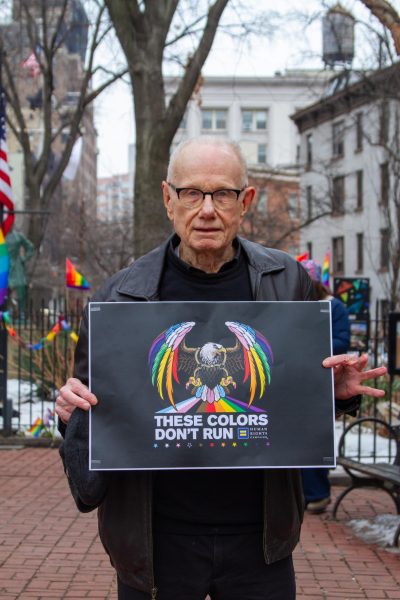
Eighty-two-year-old Greenwich Village resident Bill Dolive recalled the night he joined the 1969 uprising.
“It was about midnight when we emerged from the Christopher Street subway station, preparing to cap off the evening with a drink at the Stonewall, my favorite bar. As we exited the station we were surprised to see helmeted cops, flaming garbage cans, paddy wagons … and glorious, noisy chaos. I joined the fracas on the five subsequent evenings of disorder, but little did I realize the profound significance of those events,” Dolive said. “To many of us we just wanted the cops out of our bars. And now this outrage – the desecration of our park, our flag, our heritage. I’m as pissed off now as I was then.”
Dolive has attended nearly every Pride event held in Greenwich Village since the late 1960s and was in attendance this past Sunday.
“I guess these battles are not over. I’ve been a villager since 1967 and I’m not going anywhere. We won’t go back,” Dolive said.
The Pride flag returned to its rightful place overlooking Stonewall on Thursday, Feb. 12, surrounded by hundreds of supporters.