
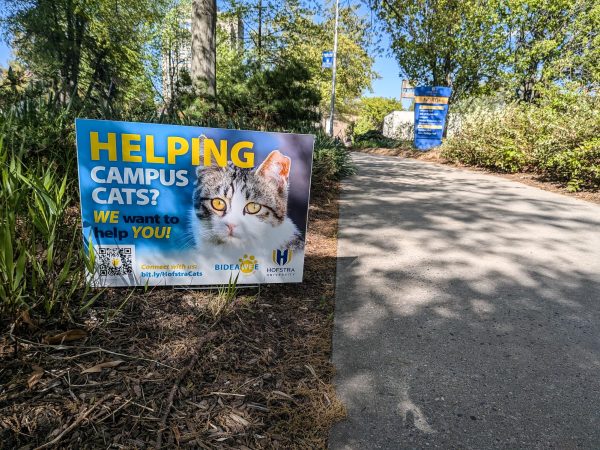
Hofstra University’s campus has been home to cats since before its founding. However, Hofstra’s administration has recently created a new partnership with Bideawee, a nonprofit organization dedicated to large-scale Trap-Neuter-Return (TNR) and community cat care.
“As the secretary of our school’s animal rights club, I and the rest of my board felt that before this partnership was announced, it was very unclear what the stance or attitude was towards the Hofstra cats or how to get involved with caring for them,” said Arietta Xylas, a senior biology major and secretary of the Student Organization for Animal Rights (SOAR).
Up until now, there has been no set procedure for caring for the population of cats around campus. Through Bideawee, new programs will be created.
“SOAR is really happy about Bideawee’s plan to introduce ‘Kitty Tubes’ to Hofstra, which are much more durable winter housing for our cats than the shelters they currently have,” Xylas said. “We’re also really excited that Bideawee and Hofstra will want to train student volunteers to properly care and manage our cats.”
Bideawee’s connection to Hofstra has a deep and rich history. Founder Kate Mason Hofstra was vice president of the Bideawee Home Association in New York City from 1903 to her death in 1933. In her will, she left behind money for her 25 cats, four dogs and three parrots.
“What I appreciate about Bideawee is the acknowledgement that there is no getting rid of these cats,” Xylas said. “They are a part of campus and trying to get rid of them is futile, because more will always come.”
Chanda Washington, Hofstra’s associate to the president for Government and Community Affairs, said that the new collaboration will function based on three core principles.
“The partnership will support three core areas: [TNR], which is the only humane and proven way to safely manage the feral cat population, workshops that will share [the] best practices for feeding and caring for cats in a safe and healthy way [and] creating a system for identifying and approving shelter and feeding locations,” Washington said.
Spencer Hamilton, a freshman forensics science major and treasurer of SOAR, emphasized the mutual goal between Hofstra and Bideawee.
“[TNR] will be key to keeping the population from growing too much,” Hamilton said. “[Bideawee is] also meant to assist with getting them some better shelters, which is wonderful. Overall, I think everyone has the same goal of helping the cats.”
The partnership between Hofstra and Bideawee stemmed from rabies concerns around the Long Island area.
“Nassau County’s alert regarding rabid raccoons is what prompted us to develop a safer way to address the requirements in the alert while still allowing individuals to care for the cats,” Washington said. “Bideawee provides the expertise we need to do that.”
Although the program aims to protect cats throughout the campus, Xylas expressed SOAR’s concern around the bird sanctuary as well.
“As we have many cats on campus that I believe are fed [and] given shelter near the bird sanctuary, a lot of the cats will go in and kill a lot of the birds,” Xylas said. “This is a concern with cats in general and is valid. I do not believe there is a perfect solution, but I suggested in a meeting with Bideawee that we keep this in mind and that they try to avoid that region of campus when placing shelters or selecting designated feeding grounds. It’s important we try and consider all the animals in our ecosystem, while also acknowledging that no choice will be perfect for all of them.”
Leslie Granger, certified animal welfare administrator and president and chief executive officer of Bideawee, expressed the organization’s perspective on the partnership in a statement.
“For years, many of Hofstra’s staff, faculty, students and surrounding community residents have tirelessly provided daily care for the cats on its campus,” Granger said. “However, without coordination and additional resources, it can be nearly impossible for individuals to humanely and effectively manage such a large population. Together, as partners, we will help provide the supportive services and resources necessary to create the healthiest and most humane future for Hofstra’s residents – feline and human alike.”