
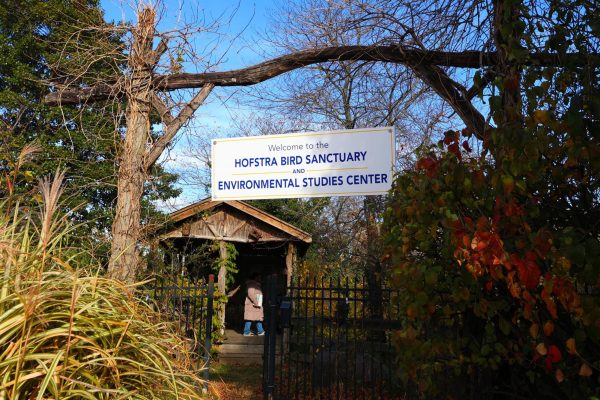
After years of inaccessibility, Hofstra University’s Bird Sanctuary has opened its doors to visitors. Featuring benches, boardwalks and platforms above wetlands surrounded by foliage, the newly restored sanctuary aims to provide students with a refuge from an otherwise bustling university campus.
Located behind the University Club on the north side of campus, the Bird Sanctuary has long flown under the students’ radars. Gates to the grounds were locked and access was limited to official use only. For many years, the area was in such disrepair that it was off-limits completely.
J. Bret Bennington, chair of the Department of Geology, Environment and Sustainability, noted that what Hofstra now boasts as a lush and inviting environment was not originally intended to be such.
“They bulldozed it out to be a stormwater recharge basin,” Bennington said. “Originally, it just would have been a sand and gravel pit.”
The area collected and drained stormwater from Hempstead Turnpike and nearby parking lots, but over time, blowing winds and the accumulation of seeds brought to the basin by birds led to naturally growing vegetation.
Hofstra received its official designation as an arboretum in 1985. As part of ongoing efforts to bolster the natural environment on campus, the university decided to turn the stormwater recharge basin into a bird sanctuary. Hofstra hosted a contest challenging landscape architects to submit blueprints for the space in 1993. The winning pitch outlined the wetlands, boardwalks, platforms and gazebo that define the Bird Sanctuary today.
In its early days, the bird sanctuary was mainly used for classes. Since it was a stormwater recharge basin, New York State law required the grounds to be locked if not supervised by an official representative from Hofstra.
Superstorm Sandy devastated the East Coast in Oct. 2012, rendering the Bird Sanctuary unusable.
“[The storm] knocked down tree limbs and trashed the boardwalk,” Bennington said. “It was completely closed for 10 years, or so.”
When the boardwalks were finally repaired and the sanctuary reopened, it was completely overgrown and teeming with invasive species.
That’s when Bennington, alongside Michael Runkel, director of Grounds and Landscape Design, began leading an ecological restoration to bring the Bird Sanctuary back to life.
“I got interested in how invasive species are taking over suburban environments like what we have on Long Island,” Bennington said. “The Bird Sanctuary seemed like a cool place to do something about that.”
The restoration has mainly consisted of controlling invasive species, replacing them with native species and establishing pollinator gardens. These ongoing efforts have been aided by involvement from local organizations, such as an Eagle Scout project that brought in a section of plants native to the American Northeast.
Now, a team of student docents work to maintain the grounds and guide visitors.
“We go around sweeping the leaves and picking up any litter that we see around,” said Adalia Rezki, a junior geology major working as a student docent. “And then we also give tours.”
Sophomore sustainability major Grason Jess, who also works as a student docent, said that boosting engagement with the Bird Sanctuary after so many years of restrictions has been an uphill battle.
“Very few people know about [the Bird Sanctuary],” Jess said. “And of the ones that do know about it, very few have even been in here.”
For these docents, working in the Bird Sanctuary has already been impactful.
“Just learning the names of the native species and being able to identify them outside of campus is pretty cool,” Jess said.
Luca Connor, a graduate student studying sustainability, noted that the Bird Sanctuary could serve as a model for other possible improvements at Hofstra.
“It inspires you to think about different ways to make the campus better than it already is,” Connor said.
The docents said they hope that their student peers will discover the Bird Sanctuary over time.
“This is kind of special to have on campus in an urban area,” Connor said. “Take advantage of it while you’re here. Maybe it’ll spark some new interests, or even just spark a new appreciation for nature.”
Bennington said that he hopes that students will utilize the opportunity to immerse themselves in nature that is close to their classrooms.
“If everybody took a half hour every day to just be in nature, we’d be a lot happier,” Bennington said. “There’s a lot of research that has shown that just looking at trees changes your whole mental state.”
According to the National Institute of Health, being exposed to nature has been linked to improved cognitive function, brain activity, blood pressure, mental health and sleep.
Since it is a stormwater recharge basin, access to the Bird Sanctuary still requires supervision by faculty or student docents. Currently, the Bird Sanctuary is open from 1 p.m. to 3 p.m. on Mondays and Wednesdays, noon to 2 p.m. on Tuesdays and Thursdays and noon to 3 p.m. on Fridays.