
In 2021, Hofstra University’s chapter of the American Association of University Professors (AAUP) agreed not to pursue negotiations of their contract and not to take their contractual raise because of the university’s concerns about the effects of the COVID-19 pandemic.
“[In 2022,] when they came to us to maybe push another year, we were having a new president and provost in,” said Anthony Basile, the Hofstra Chapter AAUP president. “Then, the union said to them in response, ‘Why don’t we just extend the existing contract until 2026 instead of doing a new contract or expecting the new administration to negotiate the minute they get here. They don’t know the faculty.’”
The AAUP has not negotiated its contract since 2016. This year, they’re looking for some changes.
“From our side, because I can really only speak from our side, we’re just looking for fairness,” Basile said. “You know, things that will keep up with the cost of living. We are really committed to the students. The overwhelming sentiment among the faculty is that we really want to make sure that we can do what we do for the benefit of the students.”
The AAUP represents both adjunct and full-time faculty. The union wants to make sure they fairly represent both employment types.
“Faculty are important to any university,” Basile said. “We have always tried to have the best faculty and in order to do that you have to be competitive and you have to be fair. We’re finding that – especially with the adjuncts – that we’re losing adjuncts to other schools that do a little bit better financially.”
Currently, the AAUP has completed three of their 15 meetings to discuss contractual changes.
“We’re gonna be talking about [issues] like, ‘Are we gonna keep the same healthcare? What’s the cost gonna be? Are we gonna change it? How will those things be determined? When can they be changed?’” said Mary Anne Trasciatti, Hofstra’s director of the Labor Studies Program and member of the bargaining committee. “Hofstra’s changing. We’re a [Research 2] university now, so we’re becoming more research focused. What does that mean for faculty?”
At their meetings, the university and the AAUP each address amendments that they would like to see, and they negotiate each term until an agreement is made.
“We didn’t have to give up our raise during COVID,” Basile said. “It was contractually negotiated. We were entitled to it, and our membership took a vote. Almost all of us agreed to forgo that raise we were entitled to. The university had the best year during COVID, and we didn’t get that raise back. The administration did, but we did not. We didn’t think that was fair. We’re hoping that this administration will be fair and we’re certainly going to be fair in our request.”
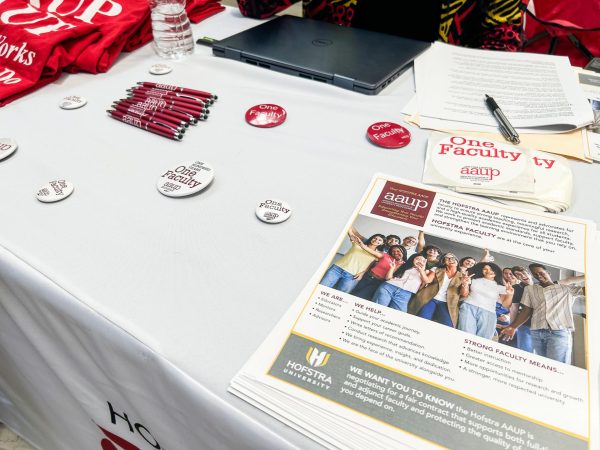
The contracts expire every five years. Since the AAUP has not negotiated their contract in 10 years, they began preparing during the summer months of 2025, looking line by line to modify sections that needed revisions.
The AAUP is the largest union to represent university faculty, and they understand their benefit to Hofstra students.
“We’re the ones who write the recommendation letters for the students,” Basile said. “When you hear about mentors in their life, it’s usually the faculty and not the administration.”
Throughout the process, the goal is to complete negotiations in the most efficient way possible, possibly even ending before the 15th meeting.
“The best-case scenario is we come to an agreement, even if it’s at 2:00 a.m. on August 31,” Trasciatti said. “We come to an agreement that our faculty overwhelmingly support, and the administration feels good about that respects our teaching and our research and our service to the community, the campus community and elsewhere.”
Although the best-case scenario is to agree on a contract, some universities across the country are struggling to make fair negotiations.
At St. John’s University, also located in New York, the administration stated they no longer recognize St. John’s AAUP Chapter’s collective bargaining agreement. The union has now taken legal action against the university, filing an Unfair Labor Practice offense with New York State’s Public Employment Relations Board.
“They struck on March 23, and it was a wildly successful strike,” Trasciatti said. “Two days, it lasted. On the evening of March 24 – the second day of the strike – they came to an agreement and they got significant salary increases in their faculty contract.”
Hofstra’s chapter of the AAUP is hoping negotiations won’t end in a negative way.
“In [the worst] case [scenario], we might consider a strike,” Trasciatti said. “No faculty wants to do that. We want to teach; we want to work; we want our students to get the education they’re here for.”
Hofstra University’s AAUP contract will expire on August 31. As negotiations continue, the outcome will not only shape faculty working conditions, but also the academic experience of students across the university.
Hofstra University did not respond for comment.
Disclosure:
The Hofstra Chronicle’s faculty advisor Brian McFadden is a member of AAUP. The faculty advisor provides guidance on professional standards and supports student staff but does not affect content.