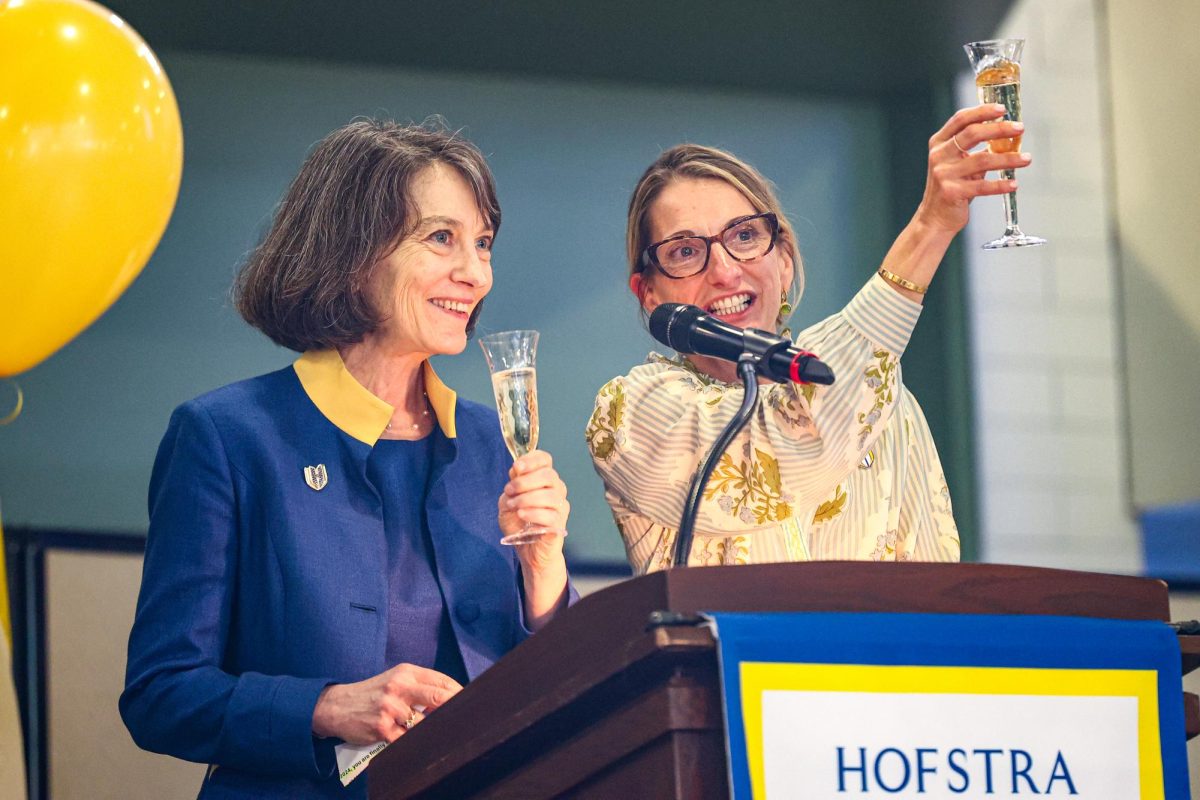

An exhibition titled “Love is the Message” at Hofstra University’s Art Museum celebrates acclaimed street photographer Jamel Shabazz’s 50th anniversary in his profession. The exhibition will be displayed from Tuesday, Sept. 2, through Dec. 16, at the Emily Lowe Gallery.
“Love is the Message” marks the first solo exhibition for Shabazz, a longtime Hempstead, New York, resident whose work spans five decades. Shabazz’s photographs capture themes of family, friendship, community and hip-hop culture through black-and-white and color photography. His work has been described as “acts of care and quiet activism” that “serve as a visual record of [African American] history from the 1980s to the present,” according to a flyer distributed at the event.
The exhibition was curated in collaboration with “Team Love,” a group of artists and community members from the Hempstead and Uniondale, New York, area. The team, which includes Shabazz, drew on work from the artist’s personal archive to create the exhibition.
The 1973 song “Love Is the Message” by MFSB – which Shabazz says is central to his artistic philosophy – inspired its title, according to Hofstra Museum of Art Director Alexandra “Sasha” Giordano.
“We actually have an album in one of the cases from the artist’s archive because this song was really important to him,” Giordano said. “It’s the ethos of the exhibition; this idea that love is not just an idea, but love is the way forward.”
Shabazz’s work is featured in the collections of the Whitney Museum of American Art, the Studio Museum in Harlem and the Smithsonian’s National Museum of African American History and Culture. He also received the 2018 Gordon Parks Award and the 2022 Gordon Parks Foundation/Steidl Book Prize.
“Society as a whole is divided a lot, and if we realize that love is all around us; not just romantic love, but platonic love, sibling love, brotherhood, et cetera… Through these pictures, hopefully, people will be inspired,” said Katie Kim, a junior in the Physican Assistant Program at Hofstra.
Alongside Shabazz’s photography, the exhibition features two works sponsored by the Art Bridges Foundation: “Native Son (Circus)” (2006) by Terry Adkins and “Bronzeville at Night” (1949) by Archibald John Motley Jr. The Motley piece is the only painting on display.
“There’s a lot of motion in this [painting]. It’s very busy, but you can see every single detail very well,” said Ryan Romanelli, senior television production major, in response to the Motley piece. “You can feel the night. It’s also very Harlem Renaissance-like.”
The exhibit’s versatility aligns with Hofstra’s 10-year strategic plan, Hofstra 100, through its multiangled insights into race, culture, history and gender. According to Hofstra’s website, the strategic plan’s goal is to provide “unique opportunities for interdisciplinary study” and empower students to “use their education to realize their dreams and ambitions and make meaningful contributions to their communities.”
“Classes are already planning to come and visit the exhibition,” Giordano said. “It’s just so interdisciplinary because it brings all of these things together in one space, and it also supports students. It supports students as a safe place to come and have a conversation. It supports students because it also shows representation, and it makes them feel seen and heard on our campus.”
The exhibition project will be accompanied by panel discussions, guided tours, meditation sessions and other public programs. The events kick off with a celebration on Wednesday, Sept. 17, at the Emily Lowe Gallery.
“In these challenging times, when societal divisions often overshadow our shared humanity, this collection of photographic works by [Shabazz] serves as a powerful antidote,” said curator Erik Sumner in a curatorial statement.
Shabazz has described his practice as a kind of alchemy, freezing time and motion. In this exhibition, his photography delivers a timeless message from the past: love in the face of change.