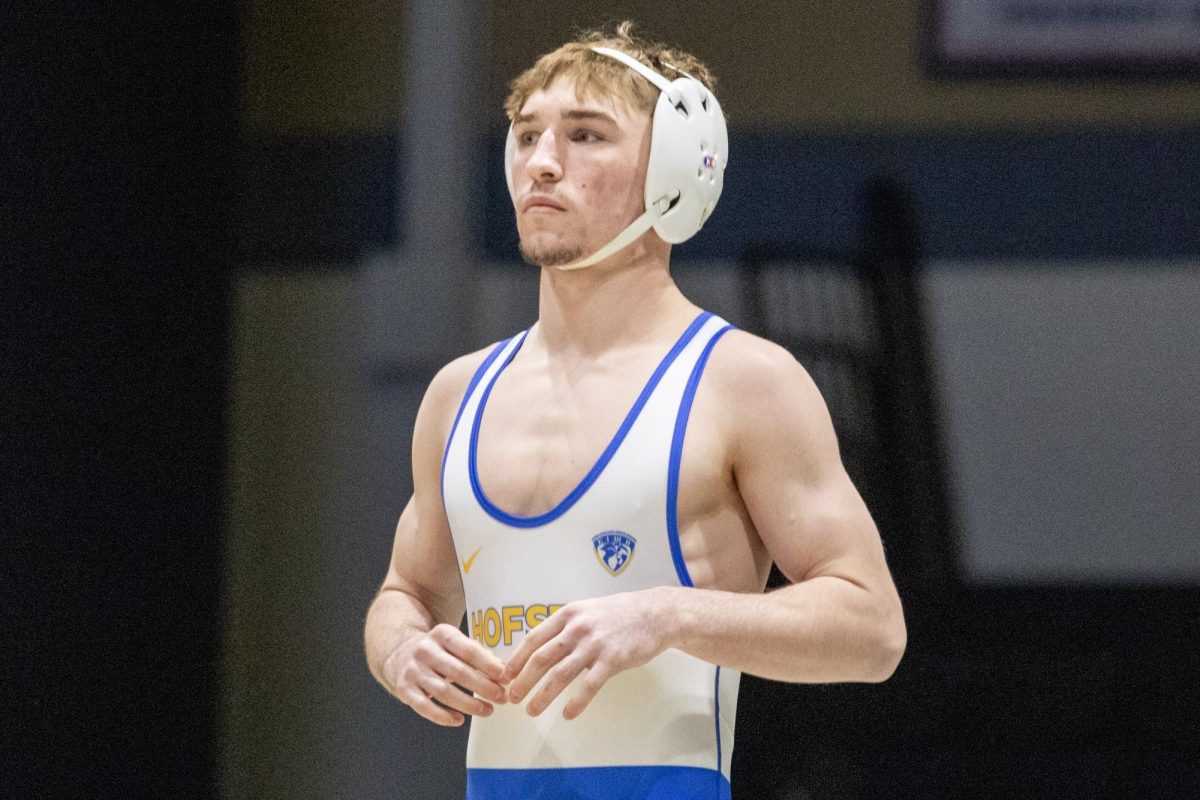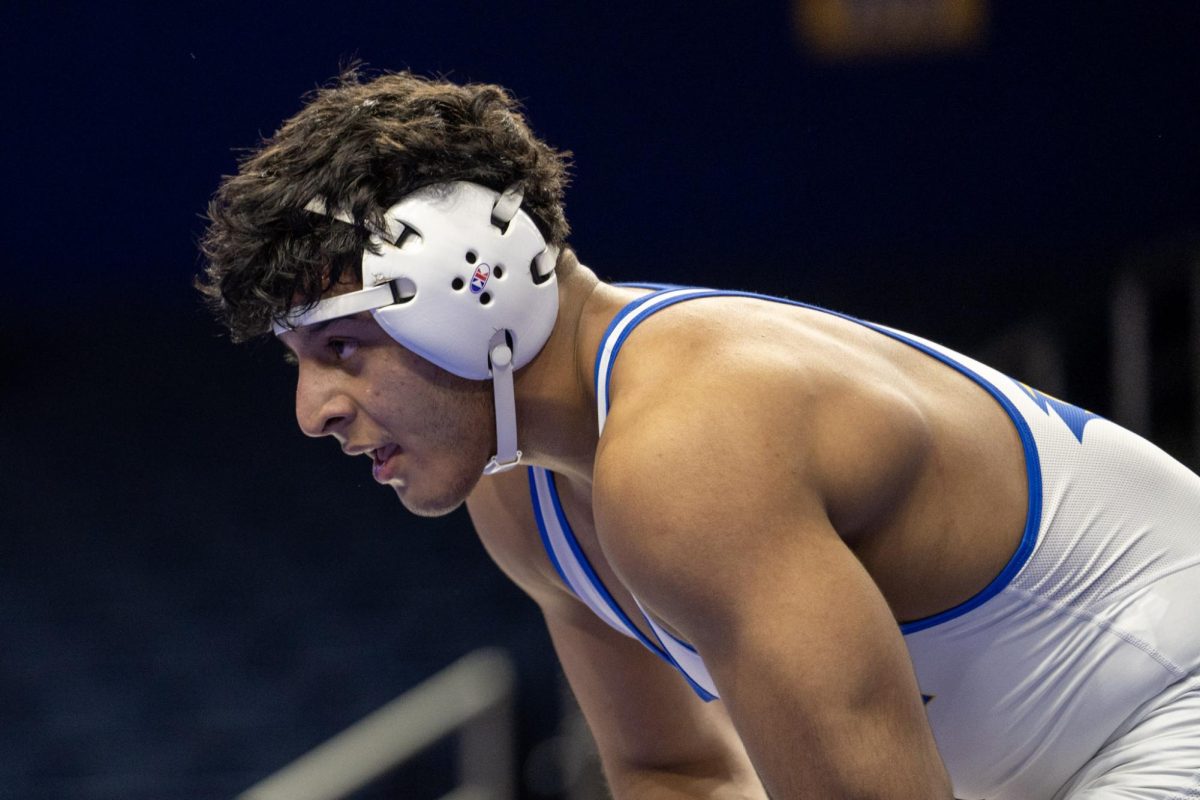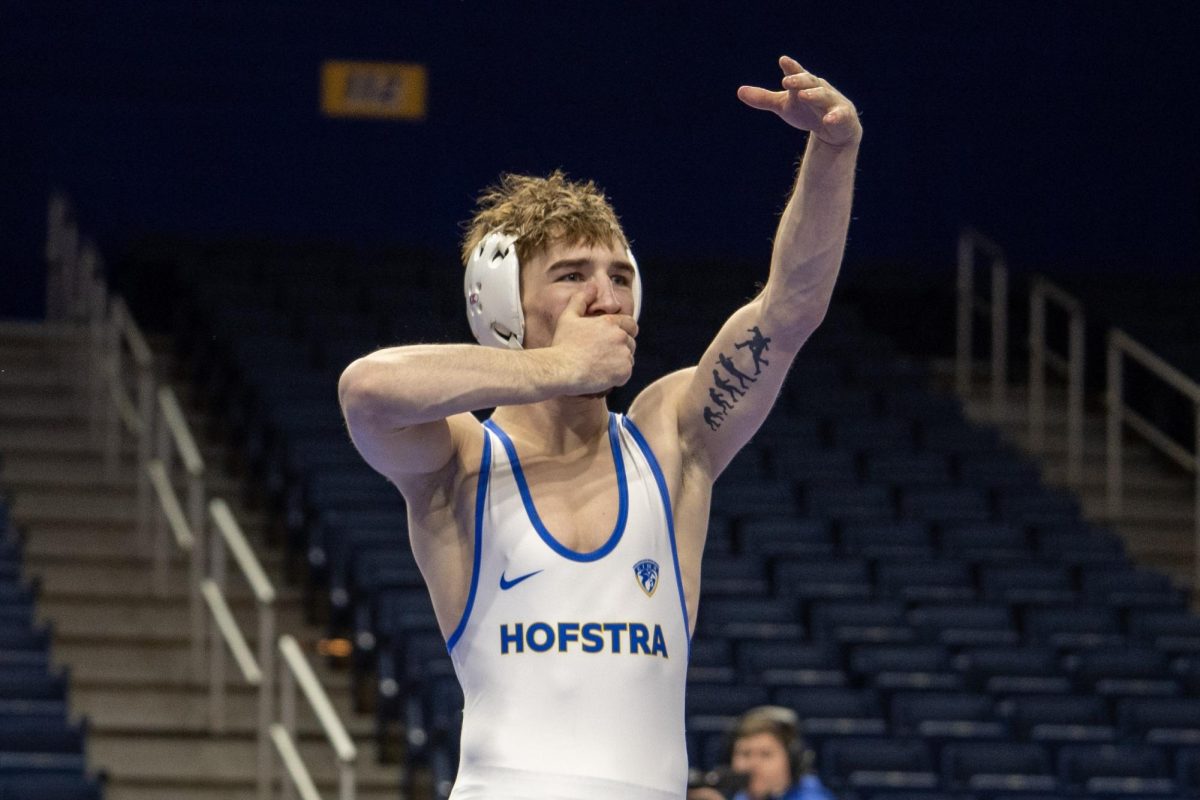

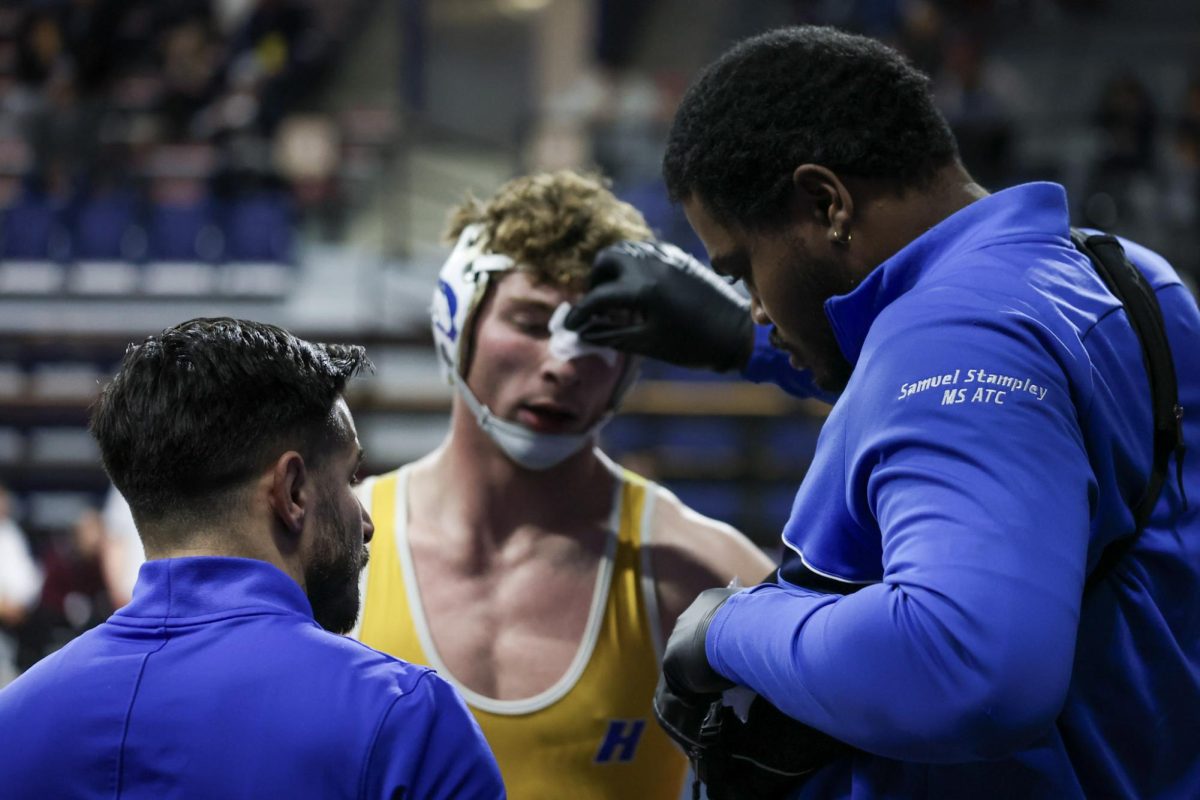
Athletic trainers aren’t known for stealing the spotlight, but for the Hofstra University wrestling team, Samuel Stampley is hard to ignore. In a room built on discipline, weight cuts and grit, Stampley always makes sure there’s still space for laughter.
“[Stampley’s] the best,” said wrestler Jurius Clark. “He’s always there for us. He is a great trainer, but he’s also like another guy on the team … and he always comes with the jokes. He’s the man.”
Stampley didn’t grow up knowing he wanted to be an athletic trainer. He describes his younger self as “kind of aimless.” However, he found his direction after a series of events.
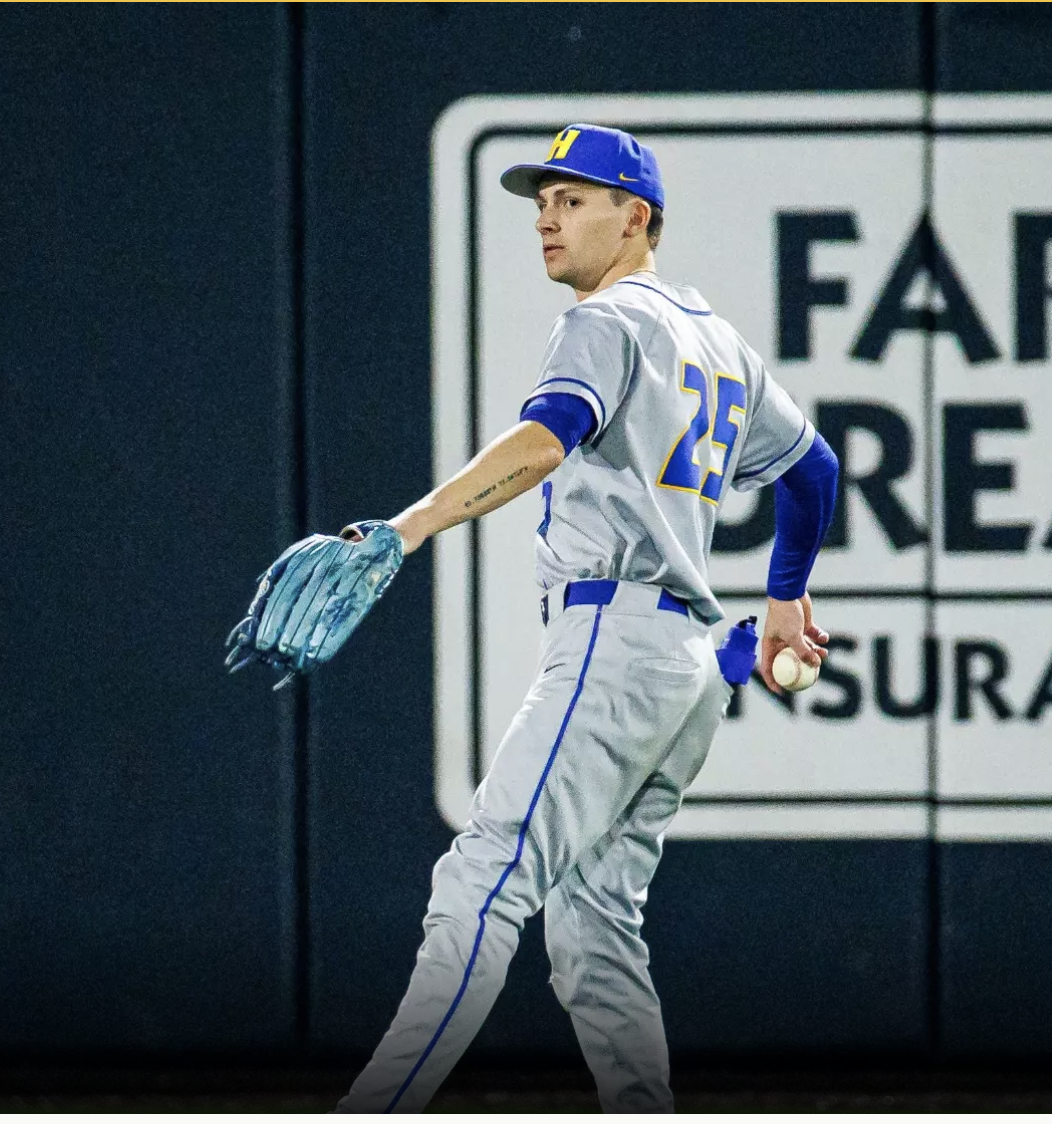
Stampley was taking an anatomy class when he tore his ACL. Later, while playing baseball at East Texas Baptist University, Stampley faced many other injuries.
“Going through that process with my athletic trainer, that’s when it first got in the back of my mind,” Stampley said. “I just was constantly hurt, was always in the athletic training room, so I just said ‘screw it, I’m gonna make that my major.’”
Eventually, the injuries were too much for him to continue his career as a player, but his experience now shapes his care, instilling in him a level of empathy and understanding that he would not have otherwise.
“I think I just have a better idea of exactly what [the players are] going through,” Stampley said. “Especially some of the sleep stuff – being tired all the time, still needing to do schoolwork – and then feeling like crap because you just practiced or you did something challenging.”
For some athletes, like Will Conlon, their connection with Stampley is personal.
“One of the biggest things for me in my relationship with [Stampley] was that we had the same injury; we both tore ACLs,” Conlon said. “There were times even in the season after I got the surgery where I’m still doubting myself … and he was the guy who had my back, offering me encouragement, saying he was in the same boat.”
On a typical day, Stampley is there before practice begins. He sets up the hot tubs, tapes joints and runs rehab sessions for the injured athletes. After practice, he’s icing, treating and preparing them for the next day.
Meet days are even longer. As the trainer for wrestling, Stampley has to manage weigh-ins and skin checks, while also working before, during and after the dual.
“It could turn into a 10-, 13-hour day,” Stampley said.
Still, Stampley shows up every day with seemingly endless and infectious energy.
“[Stampley is] a goofball,” said wrestler Alex Turley. “He’s always joking around, not taking things – stuff – too seriously, which I think is good. Sometimes some of us take it a little too serious, so it kind of balances out a little bit.”
Seeing Stampley is what marks the start of the day for the wrestlers.
“I look forward to coming in the morning,” Turley said. “It’s always a good time. We just kind of talk crap and just joke around every morning. He always writes something stupid on the whiteboard or something.”
That whiteboard is known beyond just the team. It is a canvas for debates, jokes and the kinds of crazy questions that only make sense that early in the day.
“When I come in
, he’s usually pretty energetic, got something written down on his famous whiteboard,” Conlon said. “He’s got some funny thing he wants people to debate or a question he wants people to talk about. I think [the white board] just contributes to a positive atmosphere.”
The camaraderie Stampley shares with the team makes all the long and hard days worth it.
“I’d probably say my favorite moments, honestly, are just right in the morning before practice,” Stampley said. “We just cut up; we say all kinds of nonsense between all of us. Getting to do handball … the camaraderie. It wasn’t exactly one moment but continually being around all the guys all the time – I would say – is my favorite moment, if I had to pick.”
For Stampley, athletic training is more than just addressing physical ailments. The guys on the team trust him and rely on him for support.
“Win or lose, he’s always there, calling us his little demons,” said wrestler Chase Liardi. “I think his support means a lot and he just brings that good, happy energy.”
“He’s very vibrant,” Clark said. “You’re never really going to catch him in a bad mood.”
This dynamic is very important to Stampley, who doesn’t lean on authority to connect with athletes. Instead, he intentionally avoids it.
“I probably shouldn’t say it, but it does sometimes feel like being teammates,” Stampley said. “But I appreciate that, though, because I can feel their gratitude. It feels authentic – the interactions between us … I prefer it that way instead of taking some sort of authoritative stance. I honestly don’t think kids these days respond well to that stuff anyway.”
Stampley has worked across multiple sports and roles. He was the head athletic trainer for a school district back in Texas before working at Long Island University. He’s
been at Hofstra since the spring of 2022 and works with wrestling as well as men’s and women’s tennis.
For a sport such as wrestling, where getting injured is almost unavoidable, and many wrestlers feel pressure to push through pain, having someone literally in your corner can mean the world.
“I’m there to help you, not scare you away,” Stampley said.
Liardi recalled dealing with a lingering knee injury during the season.
“He basically told me, ‘It’s not getting better; we just have to try to manage it,’” Liardi said. “So he helped me out in that way, just telling me what to do recovery wise.”
“He’s starting to really understand wrestling after all the years that he’s done it,” Conlon said. “And the knowledge that he’s able to bring in terms of words of encouragement or advice for us, specifically with what he can help us do with our injuries, it means a lot to us.”
For all his energy, Stampley is honest about the sacrifices it takes to work in college athletics.
“In order to be here, sometimes I’m sacrificing a lot,” Stampley said. “I’ve missed out on birthdays; I’ve missed funerals this year; there are friends I haven’t been able to keep in touch with. You have to make sacrifices to make it work, and some of the sacrifices are a lot, but when you get to come here and serve guys that are great to you, as these guys are, it’s really not that bad of a deal, truthfully. When you’re serving people who enjoy what you do and what you do for them, it’s a rewarding process.”
On paper, Stampley’s role is to keep athletes healthy, but he does much more than that. He knows when to push his athletes, when to listen, when to jump in with a joke and when to simply be there. He’s a steady presence in an unpredictable sport. A source of energy in the morning. He is a part of the team.
The official wrestling season might be over, but for Stampley, the work never ends. Whether it’s tennis, off-season work or another early morning laughing with the athletes, he’ll be there. For Hofstra athletes, having someone like Stampley in their corner means the world. And for him, that’s the real reward. Although, if you have them, he’d never say no to some Nerds Gummy Clusters or Skittles.