On Feb. 2, a post on Fizz, a social media application for college students, went viral for showing a video of two cockroaches allegedly sitting on a toilet in a Hofstra University dormitory. The anonymous post received about 1,400 interactions but has been taken down from the platform since then.
With the warmer months approaching, the seasonal bug scare is right around the corner.
In an informal poll of 2,058 people, many Hofstra students reported that bugs have been an unsolved problem in residential living. Around 62% of students agreed that they, or someone they know, have experienced unwanted insects in their dorms.
Allison Kosteck, a freshman music education major, recently found a caterpillar in her dorm in Tilburg Hall in the Netherlands Complex.
“I was in Rhode Island for five days for a conference, and I came home to find that we had a new roommate,” Kosteck said. “You can imagine my surprise when I looked inside [the enclosure] and found a caterpillar. It’s been kind of fun to watch her grow and get ready to turn into a moth.”
Kosteck is one of many students who have experienced a similar scenario.
Alexis Mitrakis, a sophomore psychology major, dealt with a few spiders in her dorm in Portsmouth Hall.
“Last week, I was sitting on the couch, and I thought I saw a piece of fluff, so I moved my hand and I saw that it was a spider dropping from the ceiling,” Mitrakis said. “I was freaking out because I was like, ‘How am I even supposed to get it?’ and it crawled back up the web. It’s actually my biggest fear.”
Unfortunately, she said this has been a recurring issue for quite some time. Mitrakis said that she had similar issues in her Stuyvesant Hall dormitory last year.
“I had to spray Raid down the drains because [bugs] were crawling up the drain,” Mitrakis said.
One story, in particular, caused quite a buzz back in Sept. 2025.
Noelle Anderson, a sophomore forensic science major, kept waking up to find bees in her room in Portsmouth Hall in the Colonial Square Complex.
“We would find dead [bees] on the floor or they would be flying around,” Anderson said. “It was crazy. We kept opening the window and trying to get them out.”
The bee problem persisted, invading the dorm of Anderson and her roommates for around two weeks. The problem hit its peak when Anderson was stung by a bee.
“One morning [when I woke] up, I just went to move my foot and suddenly I [felt] the sting,” Anderson said. “It was a Sunday. I was not in the mood; I had reached my limit.”
Anderson said that her family has a history of allergic reactions to bees and there was a possibility that she would react badly to the sting.
“My foot blew up,” Anderson said. “I ended up going to CVS to get stuff to help it, but the swelling wasn’t going down.”

She scheduled an appointment with Hofstra’s Wellness and Campus Living Center, where she was told to take Benadryl. When the swelling still didn’t subside, she went to urgent care.
“The guy looks at my foot and goes, ‘Yeah, you’ve got an issue. That is not going down,’” Anderson said. “My insurance didn’t cover it, so I was out 120 bucks. I had to go on medication three times a day for one week.”
The issue seemed to be bigger than Anderson’s dorm.
“There was a beehive right by my window, but it wasn’t just my dorm,” Anderson said. “Apparently, the whole building kept finding bees. They kept finding them in the hallways, they were floating around or they were finding them dead.”
Anderson and fellow Portsmouth Hall residents discussed the issue in the resident hall’s GroupMe chat. Anderson was directed to email Residence Life (ResLife) after submitting two work request orders which received no response.
“ResLife basically told me that I needed to email [building maintenance] so I kept getting redirected three different times,” Anderson said.
The work order was addressed after the weekend.
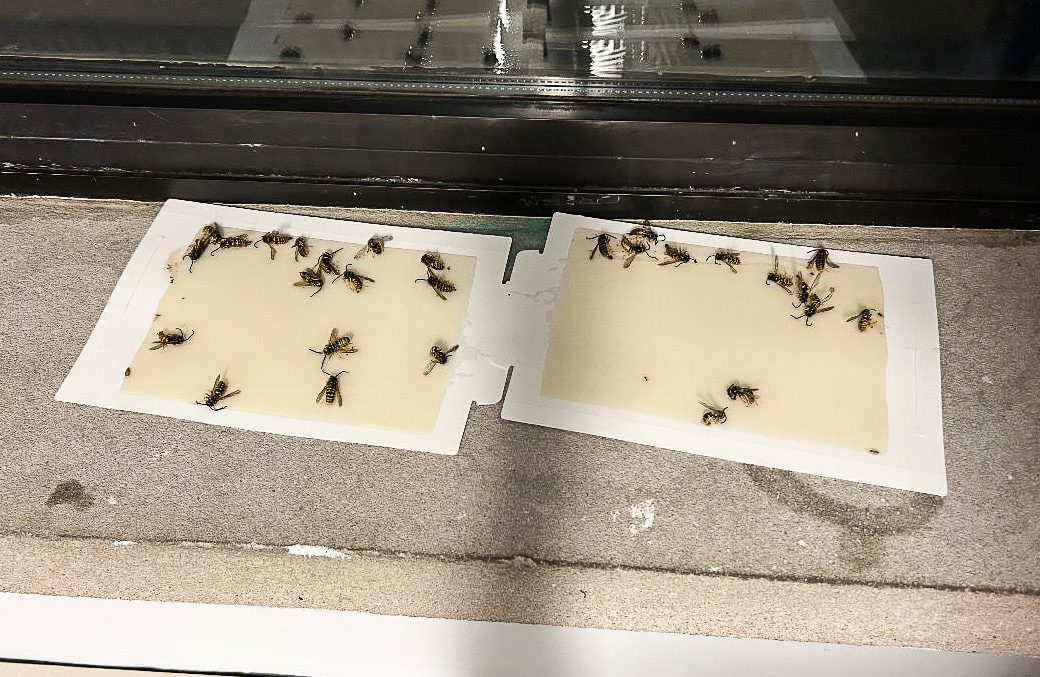
“They put these sticky traps on my windows and around my room,” Anderson said. “They told me that they were going to remove the hive and that [the bees] were just gonna get stuck on the traps. They think [the bugs were getting in] from a crack in the windowsill.”
This seemed to be a temporary solution for a more permanent problem, as the crack in the windowsill was identified but was never fixed.
ResLife was contacted for comment on the recurring bug issue and their solution.
“Facilities staff regularly walk through the residence halls and when they notice areas where cracks in concrete or gaps around fixtures could allow insects to enter, they submit work requests so carpenters can seal and repair those areas,” said Novia Ramsay, executive director of Residence Life, in an email statement. “The University also conducts preventative pest-control treatments in residence hall buildings as part of its routine maintenance program to help reduce the presence of insects.”
Anderson is waiting for the spring to see if this issue resurfaces.