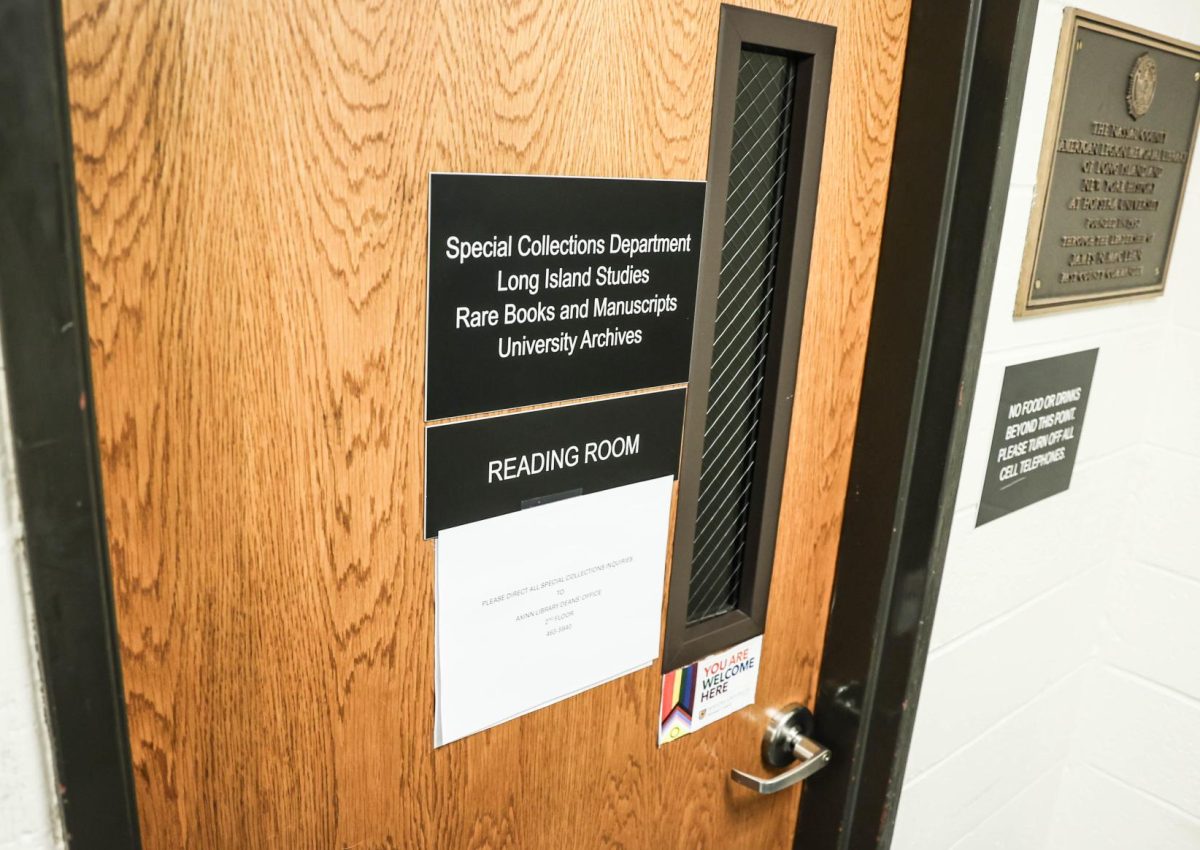
Searching for historical materials in dusty bookshelves will soon be a thing of the past at Hofstra University. The Long Island Studies Institute (LISI) at Hofstra has received a $459,000, three-year federal grant to digitize historic and regional documents that will increase accessibility and visibility of Long Island history.
The grant will aid significant investment in the technological infrastructure of the university’s archives of Long Island history by expanding public access through digital initiatives. The grant will go toward new scanners, archival space, technical infrastructure for finding student aids and other facilities.
Last year, Chanda Washington, associate to the President for Government & Community Affairs at Hofstra, approached the Axinn Library’s administrators with the opportunity for possible federal funding. The grant offer was championed by United States Senator Chuck Schumer through the Financial Services and General Government appropriations process.
“We’re working on making our collections much more accessible,” said Sarah McCleskey, vice dean for Administrative and User Services. “We’re trying to work on the visitor experience. [We are] trying to just improve access, improve our intellectual and physical control of the collections.”
As part of this digitalization, LISI is participating in the JSTOR Digital Stewardship Services charter program. The JSTOR platform was started in 1994 as a way of converting printed journals into digital forms. The Stewardship program is a two-year initiative that invites institutions to allow them to develop their artificial intelligence (AI) technology.
McCleskey said that AI has helped with the description and transcription of two Hofstra archive collections that are currently available on the JSTOR platform. She also noted that the AI transcriptions were checked twice before publication.
“[The JSTOR platform] made a transcription for us, so we were able to compare the one we had, that a person made, with what the AI had done, and between the two of them, you come up with a really good transcription,” McCleskey said.
LJ Forest, a sophomore writing for the screen major, is a student aid at the LISI archives. He said that the initiative integrates historical research with curriculum, supporting his historical interests in class projects and assignments.
“It’s a great opportunity for students to get more involved with the archives, because we are sort of tucked away in the corner down here,” Forest said.
So far, 33 libraries and archives have signed up for the charter program in order to give feedback to improve “AI-assisted collections processing.” Hofstra was among the first three to sign up, according to McCleskey.
To assist with the digitalization, new positions are being added in the special collections department, such as student aids, archivists, managers and administrative positions.
Although the digitalization of all the historical documents will take longer than three years, through this initiative, the archives that were once tucked away in the Axinn Library’s basement will be able to be integrated into the curriculum to enhance the educational landscape at Hofstra.
“We’re also hoping to have students and course classes develop digital exhibits or physical exhibits based on some of these interesting documents – kind of tell the story in different ways,” said Lorrie McAllister, dean of Library and Information Services. “That’s another thing we [would] like to do.”
The impact of digital archives expands beyond technological accessibility.
“Digitalization is definitely going to help research and also accessibility because, honestly, our area is not the most accessible for anyone with physical disabilities,” Forest said. “It is not the easiest to come in here.”
Espen Johnson, a freshman urban ecology major, is a student aid at the archives. They talked about the efficiency – and the risk – of sending documents to people digitally.
“[With] the internet, there’s always the chance that something will get deleted, will get hacked, stuff like that,” Johnson said. “And, also, sometimes people will digitize things and then get rid of the original version altogether, which is always a risk and just getting rid of history. I think it’s a big asset to have things be digitizable, [but] even then, there’s some things that are just really hard to digitize. Some of these books are so incredibly old that trying to digitize them would be very dangerous to the book itself.”
The historical collections will be available through the JSTOR platform to anyone with internet access, which will dissolve the need to spend hours sorting through documents and will aid the educational experience at Hofstra.
“We have so much material that it provides such a rich pool of resources for teaching just about anything,” McAllister said.