The Emily Lowe Gallery at Hofstra University’s Museum of Art opened a new exhibition on Thursday, Feb. 5, titled “Our Unfinished Revolution,” which explores the legacy of the American Revolution. The display highlights the experiences of multiple groups who were excluded from the freedoms promised in the Declaration of Independence.
The exhibition coincides with the upcoming 250th anniversary of the American Revolution and is part of Hofstra’s campus-wide initiative, “Revolution 250: Untold Stories.”
Alexandra (Sasha) Giordano, museum director, said the timing of the exhibition was intentional.
“It was important that the exhibition overlapped with the 250th anniversary of the American Revolution and the signing of the Declaration of Independence,” Giordano said. “We wanted to bring together the exhibition, academic classes and community programming to build toward that anniversary.”
Giordano and the gallery collaborated with Hofstra’s history department, led by Sally D. Charnow, chair of the department. The partnership integrated the exhibition into research and coursework across 10 classes during this spring semester, as well as community programming.
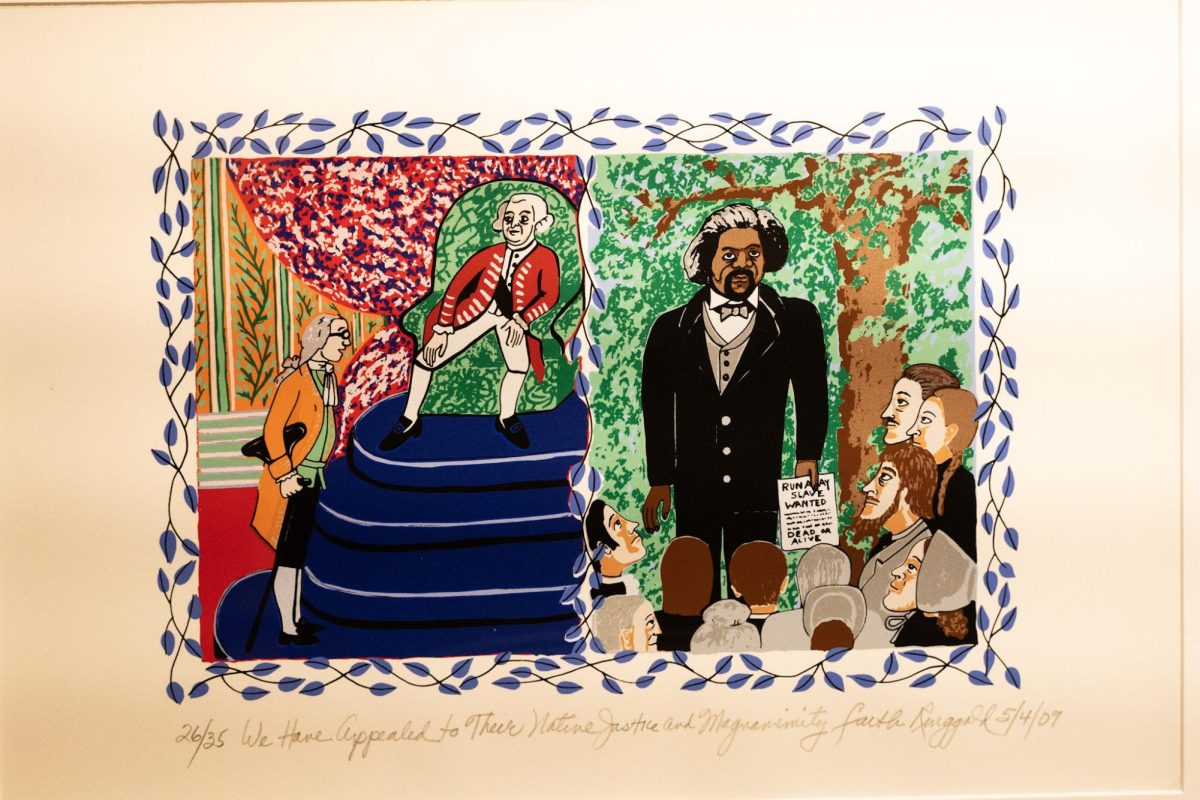
The exhibition focuses on four groups: women, Black Americans, indigenous peoples and immigrants, each of whom played a role during the American Revolution, but were largely excluded from the liberties promised in 1776.
Presley Rodriguez, assistant director of exhibitions and collections and curator of the exhibition, said that it is organized around four anniversary years: 1776, 1876, 1976 and 2026.
“Each wall represents the struggles these groups have experienced over time, while also highlighting victories related to the expansion of civil rights,” Rodriguez said.
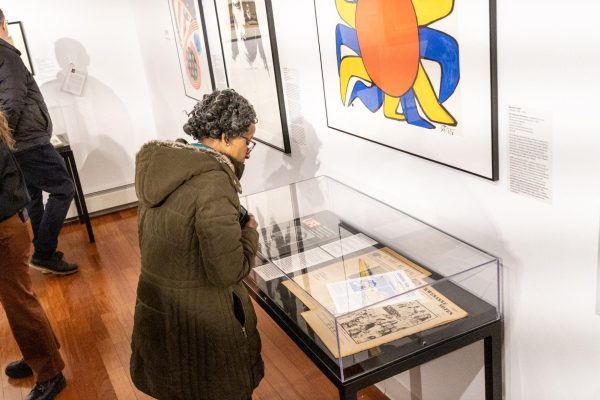
Rodriguez added that one of the main challenges during curation was balancing historical accuracy with respectful representation.
“These histories involve violence and injustice,” Rodriguez said. “We wanted to tell those stories honestly while also honoring the dignity of the people we’re representing.”
Giordano emphasized the importance of student engagement regarding the exhibition.
“It’s important that students come into the exhibition and consider untold stories of people they don’t normally associate with the Declaration of Independence and think beyond the Founding Fathers,” Giordano said. “We want students to think about history in a broader context, especially through the 10 classes that helped curate this exhibition.”
Rodriguez said the exhibition encourages visitors to understand art as a form of freedom of expression.
“When visitors come to the museum, they see how art has not only recorded history but has also opened people’s minds to different ideas and perspectives,” Rodriguez said. “These outcomes come from ordinary people coming together around common ideals, and it’s up to us to determine the next chapter.”
The artwork featured in the exhibition includes pieces selected from more than 5,000 works in the Hofstra University Museum of Art’s collection, spanning from ancient to contemporary art from various cultures. The exhibition also includes loans from other institutions and contemporary artists that Giordano said help “fill the gaps” in telling the exhibition’s story.
One of the featured contemporary artists is Jeremy Dennis, a member of the Shinnecock Indian Nation and a Long Island native, who created new work specifically for the exhibition.
Dennis said that he was invited to participate after meeting Giordano at a museum conference last year focused on planning for the 250th anniversary.
“This became an opportunity to think about Native connections to the American Revolution in a new way,” Dennis said.
Dennis contributed eight photographs, including seven from his series “Rise,” which incorporates historical references, symbolism and popular culture to explore Indigenous presence and memory.
Through his work, Dennis aims to challenge narratives that separate Native and non-Native histories. He uses his knowledge of Native culture and Shinnecock history to illustrate how Indigenous people were present on both sides of the Revolutionary War.
“I really want students to see this as a jumping-off point,” Dennis said. “I hope anthropology and history students want to learn more about Shinnecock topics and that art students see what’s possible within photography. It’s not just candid or street photography, you can use it like painting.”
Dennis added that building connections between the Shinnecock Nation and the academic community is essential.
“We’re a small nation of about 600 people, and we need as many allies as possible to amplify our voice,” Dennis said.
Students who attended the opening reception said the exhibition offered perspectives often missing from history courses.
Eleazar Sanchez Lopez, a sophomore double majoring in history and Latin American and Caribbean studies, said the exhibition highlights overlooked contributions.
“When commemorating the 250th anniversary of American independence, it’s important to reflect on those who contributed to the Revolution but aren’t often discussed in history courses,” Sanchez Lopez said. “What would America be without Indigenous people, without women, without immigrants?”
Sanchez Lopez said one of the most striking aspects of the exhibition was its focus on landscape and geography.
“The beauty of the land is almost omnipresent throughout the exhibition,” Sanchez Lopez said. “Just as the country is diverse in culture and ideology, it’s also diverse in natural beauty.”
Sara Braun, a senior art history major, said the curatorial choices strengthened the exhibition’s message.
“Seeing how contemporary works, like [Dennis’] photography, speak to older pieces was really powerful,” Braun said.
Ashley Jayne, a senior double majoring in dance and history, said the exhibition reflects how younger generations are reexamining the past.
“Our generation wants to see different perspectives,” Jayne said. “That’s exactly what this exhibition does.”