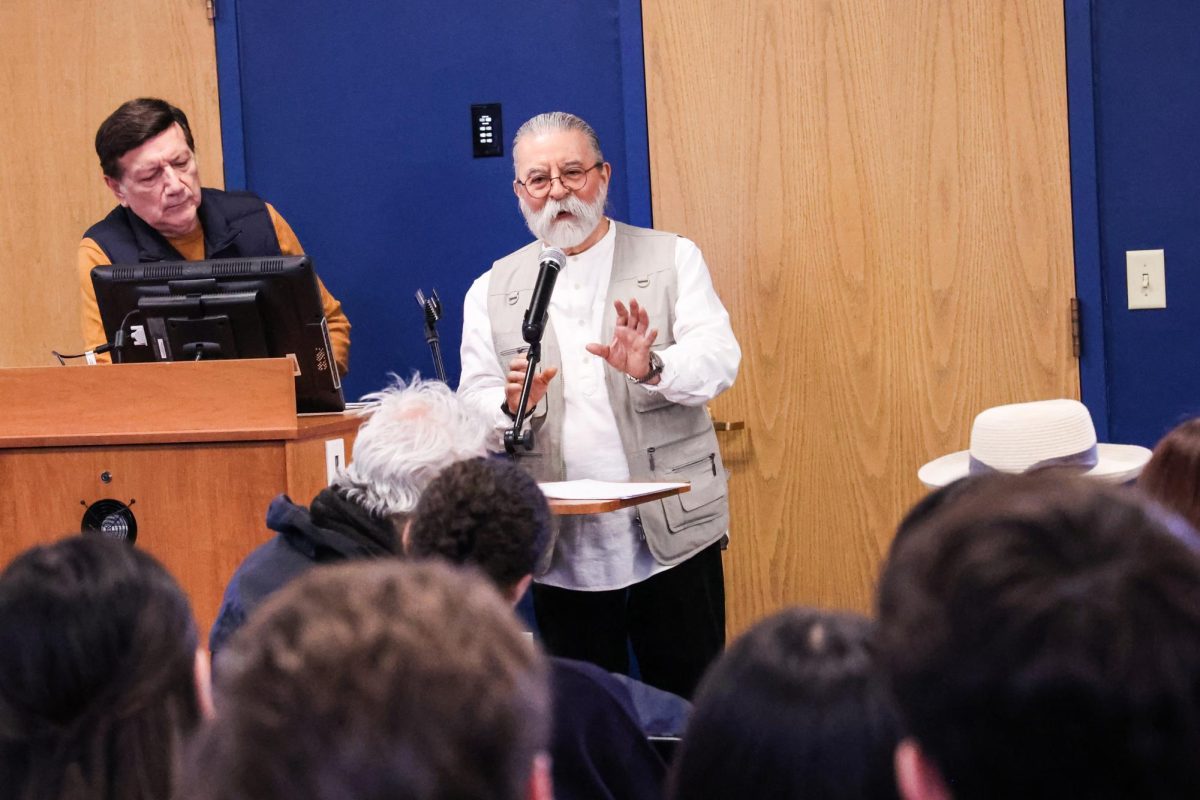

Hofstra University President Susan Poser and other administrators talked to students about ChatGPT Edu, Charlie Kirk and more at Hofstra Town Hall in the Sondra and David S. Mack Student Center’s multipurpose room on Monday, Oct. 20.
The administration fielded questions about the school now offering ChatGPT Edu, specifically about what the administration is doing to mitigate its downsides, such as collecting user data and using that data to train its programming. According to Poser, Hofstra negotiated with ChatGPT so that it is contractually obligated not to take users’ data to train its own model.
Poser talked about looking to the future with this move.
“We can’t put our heads in the sand about what is going on with [artificial intelligence (AI)] out there,” Poser said. “It’s better to be trained in it, understand it and make your own choices about when to use it and when not to.”
According to Jesse Webster, chief information officer for Information Technology Services, there were already 5,000 people who created a ChatGPT account with their Hofstra email. He wanted ChatGPT Edu to be a safer option for students to transfer to, not an effort to add more users to the service.
However, students still worry about the possibility of the program “hallucinating” – AI providing misleading or incorrect information as truth. Administrators responded to this by pointing to the AI literacy course available on Canvas, teaching students about the potential drawbacks and dangers of AI.
For Aydan Smith, senior international business major and president of Black Leaders Advocating for Change, this is a good start, but not enough. She suggested a required course, like the mid-semester courses or Title IX training that club leaders receive.
“[A course in AI can] give people the skills they need to properly use AI without making them dumber,” Smith said.
Poser highlighted that students must always check their sources and not rely on AI as a substitute.
“You can’t rely on ChatGPT to plug in a question then print the answer and hand it in as the truth,” Poser said. “You have to apply some analytical skills.”
She also emphasized that the use of ChatGPT Edu in the classroom is completely at the discretion of the professor and serves as a learning tool for students. However, some see this offer as not very useful.
“In the classes I’ve had to use [ChatGPT], I feel like I could have done the research myself to complete the assignment with just as much understanding than if I put it in a prompt,” said Annecamie Augustin, sophomore finance major and vice president of Black Student Union.
Augustin and others also engaged in a dialogue with Poser about her email in September concerning the shooting of Charlie Kirk at Utah Valley University. Some pointed out how she spoke on the Kirk shooting but not the death of Demartravion “Trey” Reed or other issues, such as Israel’s invasion of Gaza. Poser defended the statement by saying that Kirk’s death happened on a college campus and it had to do with freedom of speech.
“I tried very hard to make that email not about the particular views of Charlie Kirk,” Poser said. “But really about political speech-based violence on campus.”
She also acknowledged that Reed’s death happened on a college campus like Kirk’s did.
Poser stated during the town hall meeting that her speaking up on one issue and not another did not mean she thought one issue was more important than the other. She added that she was not aware of some issues that students brought up. Still, some said they felt that Kirk’s death could have been better addressed. Smith pointed to the Stuart and Nancy Rabinowitz Honors College’s statement on the issue as an example.
“That email was more well thought out and down to earth than what President Poser gave,” Smith said. “I felt a lot more heard from the honors college email addressing the [Kirk] situation than by Poser’s.”