Hofstra University promotes diversity in science, technology, engineering and math (STEM) through programs supporting women students and faculty inclusion efforts, but men still dominate most departments.
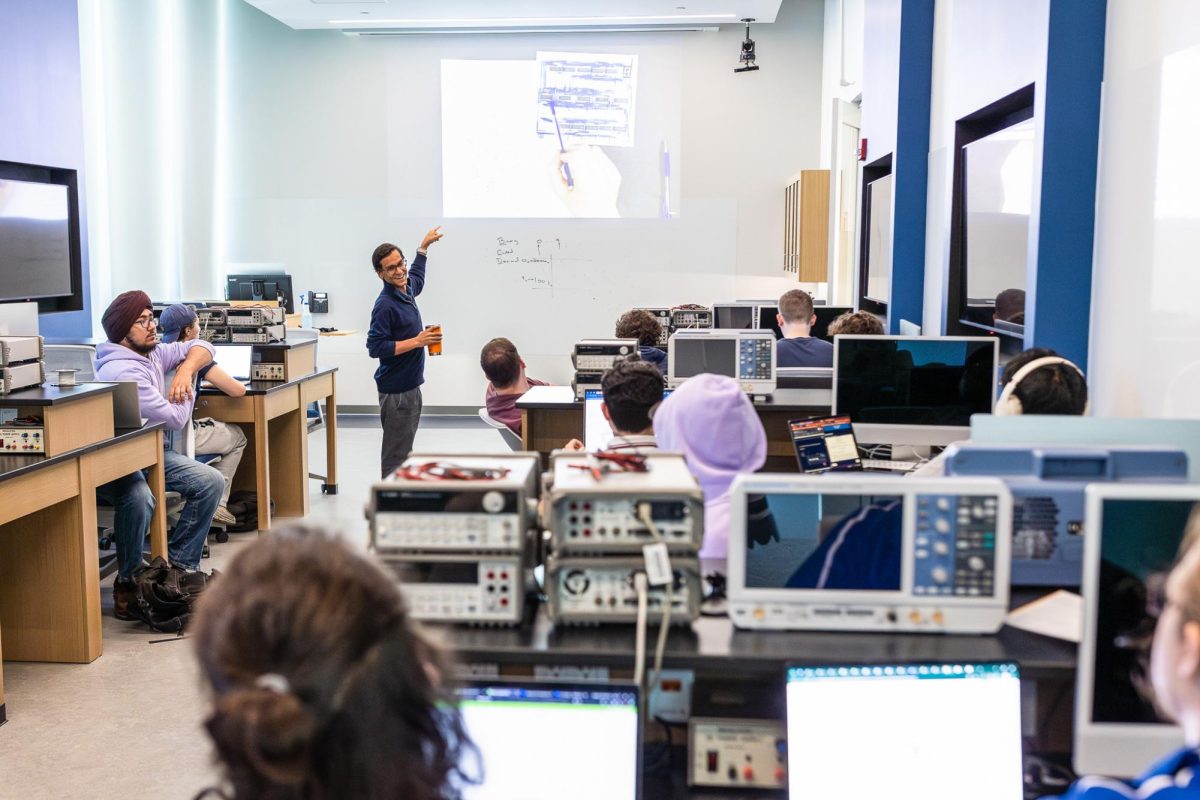
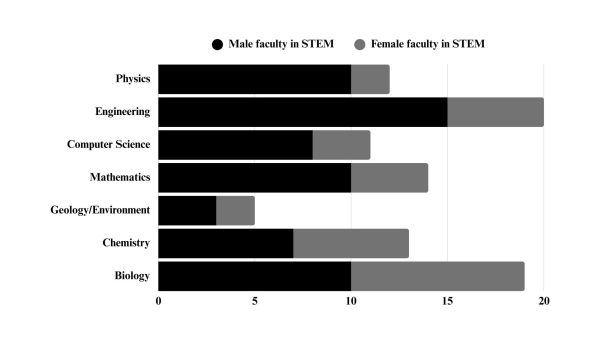
Programs like Women’s Summer Program in Computing/Engineering, which helps first-year women in engineering and gives micro-grants for faculty advancing equity, aim to improve representation. Yet, 2025 data shows persistent gender gaps: the physics faculty is 83% men, the engineering faculty is 75% men and the computer science faculty is nearly 73% men. Biology and chemistry are closer to parity, highlighting how representation varies across disciplines.
Biology and chemistry are the most balanced breakdowns, while physics and engineering have the lowest share of women among their faculty. Hofstra’s numbers largely mirror national trends, showing stronger parity in the life sciences but deep gender gaps in physics, engineering and computer science.
Research shows students, especially women, are more likely to pursue STEM careers when they see female faculty teaching and leading.
Silvia Franklin, a mathematics professor at Hofstra, explained how the pipeline problem begins early.
“Math PhDs that go to women are still under 30%,” Franklin said. She also noted that having fewer women at the highest academic levels naturally limits the pool for faculty positions, reinforcing the gender gap.
Franklin emphasized that female faculty visibility is critical to expanding that pipeline.
“It helps students see women teaching math,” Franklin said. “That alone changes what feels possible.”
Department chair Lisa Krause described a dramatic shift over time in biology.
“Now it’s completely flipped,” Krause explained, adding that about two-thirds of biology majors are women. Krause stated that the balance fosters a healthier academic culture, where mentorship happens naturally. Still, subtle biases linger.
“Female faculty are often addressed as ‘Ms.’ instead of ‘Doctor,’” Krause said. “It may seem small, but it reflects who people instinctively see as the authority in the room.”
Sophomore forensic science major Emma Rizzo described her chemistry-based program as “definitely [woman]-dominated.” She hasn’t personally experienced bias but noted that classmates have.
“Some male professors treat women students differently,” Rizzo said. “It depends on the class or the professor.”
Junior biology major Klaudia Frankowski has seen the contrast firsthand in her biology and physics classes.
“In biology, the balance feels pretty even, maybe even more women than men,” Frankowski said. “But in physics, it’s a completely different story. Out of around 30 students, I’m probably one of only six girls.”
Frankowski added that she thinks female professors often teach differently.
“They explain things more patiently and use a gentler tone, which makes a big difference in difficult courses,” Frankowski said.
Cornell Craig, vice president for Equity and Inclusion, explained how his office supports equitable faculty hiring.
“Hiring happens within departments, but our office helps make sure the process is inclusive,” Craig said. Bias training and standardized rubrics are used to minimize unconscious bias during hiring and candidate evaluation.
Craig acknowledged national pushback against diversity, equity and inclusion programs, but mentioned that Hofstra continues to prioritize inclusion.
“We’ve had to stick to our values,” Craig said. “Even as diversity programs face pushback elsewhere, we’re moving forward.”
Krause agreed that these efforts have helped.
“Bias training is helping departments consider a broader range of applicants,” Krause said. “That’s making our faculty more reflective of the diversity in our student body.”
Franklin added that equitable hiring alone isn’t enough.
“When women see leadership roles open to them, it reshapes what they think is achievable,” Franklin said.
Krause emphasized that departments should also monitor what courses are assigned to faculty to ensure that women don’t disproportionately teach only introductory classes.
Craig underscored that retention is equally important.
“We need mentorship and community, so people want to stay,” Craig said. “Recruiting women is only the first step. Supporting them once they’re here is what makes the difference.”
Hofstra continues to push for inclusion, but men still dominate most STEM departments. Biology and chemistry approach parity, yet physics, mathematics and engineering lag behind. True equity, faculty say, will take more than policy. It will take mentorship, inclusive leadership and cultural change.
“Representation doesn’t happen by accident,” Franklin said. “It happens when institutions make it a priority and keep it one.”