
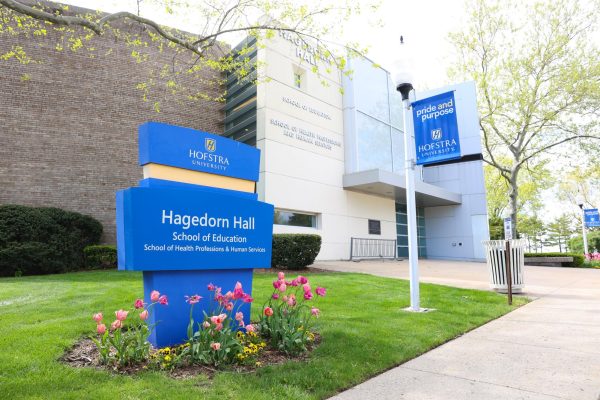
Ayana Allen-Handy bid farewell to Drexel University as she sets up for her new role as dean of Hofstra University’s School of Education, effective Jan. 1, 2026.
Allen-Handy has spent 10 years at Drexel University, starting as an assistant professor and most recently serving as professor of Urban Education and chair of the Department of Policy, Organization and Leadership.
With this new phase at Hofstra’s School of Education, Allen-Handy said she looks forward to collaborating with students, faculty and staff as well as focusing on building relationships after having spent most of her formative and adult years in the Philadelphia, Pennsylvania, region.
“Relationships are important to me – having deep roots in the community,” Allen-Handy said. “Something I’m kind of looking forward to is being able to build new relationships that can have a transformative impact with the School of Education, but also in the local community.”
Hofstra’s School of Education is being recognized nationally, ranking No. 207 (tie) out of 255 in Best Education Schools in 2025, according to the United States News & World Report’s Rankings, and most recently earned accreditation by the Association for Advancing Quality in Educator Preparation, which involves three years of data collection to mark quality.
The role of the dean of the School of Education for the past year was filled by an interim. As a part of Hofstra 100, a strategic plan introduced last year that focuses on interdisciplinary and new academic programs, community engagement, student success and organizational agility, the University welcomed Amy Catalano as interim dean.
In her time at Drexel, Allen-Handy became the founding director of the Justice-oriented Youth (JoY) Education Lab, which is focused on the pursuit of educational, racial and social justice. Along with her new administrative role, members of the JoY Lab, including some graduate and postdoctoral students, will be transitioning to Hofstra to continue ongoing grants. With this, Allen-Handy is hoping to inspire community driven intergenerational research to support pathways of research at the School of Education.
“[I hope to bring] an excitement around teaching as a field,” Allen-Handy said. “One of the things I hope to do is really accelerate recruitment to the School of Education [and] non-traditional pathways to education.”
Jessica Sucharski, junior early childhood education major and president of the National Professional Association and Honor Society for Educators (Kappa Delta Pi) chose Hofstra for its many opportunities at the School of Education. One appealing reason for her was the 250 hours of clinical experience in elementary schools that students are able to get.
However, Sucharski mentioned the limited communication and openness around research opportunities and applications for certifications, which is a gap Allen-Handy could help address.
“[Research opportunities are] not advertised as much as I would hope,” Sucharski said. “If you’re in a class with a professor and they’re working on a research topic, you’ll know about it, and you can offer to help, or they’ll ask if you want to help. But other than that, nothing is really posted about research opportunities.”
As Allen-Handy prepares to start her new position, she is planning to have a human-centric approach moving forward.
“[First, I will get] to understand what the needs on Long Island [are and] as it relates to education, as it specifically relates to educational equity across myriad differences in our kind of polarizing context that we’re living in right now,” Allen-Handy said. “Then, [I will be] able to strategize about how to collectively address challenges that may exist within the school, and then also within our local school districts or communities in Long Island and New York and beyond.”