
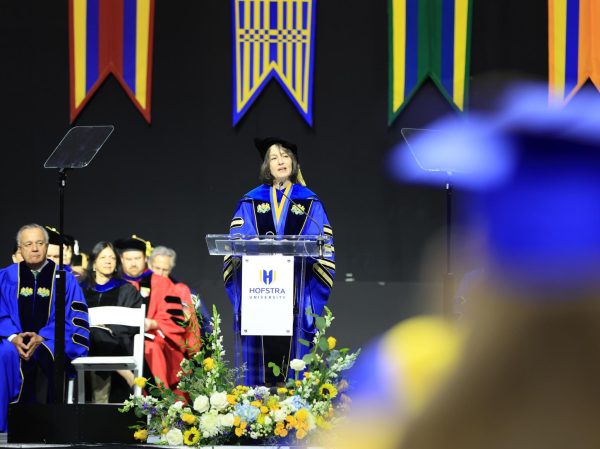
Hofstra University graduates walking across the stage will not hear their names being read by university officials in the upcoming Dec. 2025 and May 2026 commencement ceremonies. Rather, students’ names will be read by an automated program. While Hofstra has labeled this change as beneficial to ensuring the proper pronunciation of students’ names, the decision has refreshed concerns among students regarding the university’s use of artificial intelligence (AI).
“[Hofstra] is moving deeper into AI and trying to embrace it, and it feels like it’s something that a lot of the student body doesn’t feel comfortable with for a lot of reasons,” said William Jiggetts, a senior psychology major. Jiggetts will be part of the May 2026 commencement ceremonies, and he noted his aversion to walking the stage to an automated announcement of his graduation. “I don’t want to hear my name read off by an AI.”
“It’s just so impersonal and almost like a slap in the face to the students who have worked so hard to reach graduation only for a robot to say their name in a bland voice,” said Callie Holiway, a sophomore pre-early childhood education and creative writing double major.
Hofstra’s administration has framed the decision to automate the reading of graduates’ names as an effort to improve the accuracy and efficiency of the process. In a statement to The Hofstra Chronicle, the university noted that the newly implemented program is intended to “improve organizational efficiency by helping Hofstra staff manage attendance and other logistics more effectively to help deliver a smooth ceremony experience for all.”
According to the statement, the automated reading of names is just one part of several updates to the ceremony, including the presentation of graduates’ names and degrees on the arena screen as they accept their diplomas. Each graduate will also receive a video clip of themselves walking across the stage.
A major goal of the new program, however, is to ensure the correct pronunciation of students’ names. According to Hofstra’s statement, the new program will “allow graduates to listen to their names in advance of the ceremony, giving them an opportunity to hear and confirm a correct pronunciation.”
Yet, many students remain displeased with the growing role of AI in the university’s campus life.
“I’d rather [have] a human being; I might have [more] sense of connection with [mispronouncing] my name a little than a robot say it correctly,” Holiway said. “Overall, it’s just an awful situation … I don’t know a single student who likes that AI is reading names at graduation, even of the people I know who use AI.”
“And this is just the latest in a string of things that they’ve been doing,” Jiggetts said.
In June, Hofstra unveiled the new logo of the athletics department through an AI-generated video posted on the university’s @HofstraU and @HofstraPride Instagram pages. Student backlash to the video criticized the university’s use of AI instead of utilizing the talents of the student body.
Criticism culminated in a statement from Hofstra’s Student Government Association as well as a petition calling for the university to take the video down, which has amassed more than 700 signatures.
According to Jiggetts, that video, the notion of AI reading names at graduation and the recent development of ChatGPT Edu is indicative of Hofstra’s general embrace of AI.
“People are using AI more and more heavily, and they’re not doing work themselves,” Jiggetts said. “There are issues with AI taking people’s jobs, and it just feels like a bad omen.”
Hofstra is not the first university to use an AI program to read out names at commencement ceremonies. A video posted by @therundownai on Instagram shows graduates at New York City’s Pace University presenting QR codes to a school official who scanned each code before an artificial voice announced each student’s name as they walked the stage.
Other universities, such as the University of South Carolina and Northeastern University, have implemented similar practices. User @jonaitken’s comment under the video of Pace’s commencement noted that while the AI voice was “a bit monotone,” it accurately pronounced ethnic names that might otherwise be “mangled” by a regular reader.
Universities’ efforts to ensure the proper pronunciation of students’ names are clear. In May 2024, so many names at Thomas Jefferson University’s commencement were significantly mispronounced that the university issued a formal apology. Other universities are taking steps to avoid a similar situation.
Still, the use of AI in this way at Hofstra has left some students feeling like their perspectives have been ignored. Jiggetts noted the ethical impacts of AI surrounding issues like the literacy crisis, and Holiway noted the environmental impacts. To some students, it feels like their concerns have not been reflected in the university’s policy. “Read the room, you know?” Jiggetts said.